Showing posts with label Hebrew language. Show all posts

Tuesday, February 9, 2021

THE BIBLE’S BURIED SECRETS - Just as the discovery of the Dead Sea scrolls substantiated the accuracy of Old Testament writings, such as the book of Isaiah, other archaeological discoveries like the clay shard in Khirbet Qeiyafa are adding to the compelling case for the reliability of the Old Testament. And although a few scholars question Jesus’ existence, no great historian, Christian or non-Christian has drawn that conclusion. Yet as the evidence is discovered, the reliability of the New Testament continues to confound its skeptics - Has the discovery of an ancient pottery shard in excavations near Jerusalem, undone the sensational claims of a PBS documentary entitled, “The Bible’s Buried Secrets”? In that documentary, PBS shockingly concludes that the Hebrew Bible was written hundreds of years after Abraham, Moses, Joshua, and David. It cites scholars who state that the Bible couldn’t have been written until the 6th century BC because the Hebrew language hadn’t been developed until then. According to PBS, the late writing of the Bible means that the entire Old Testament is based on centuries of oral tradition that changed over time. Therefore, according to the documentary, the Bible’s stories are simply myths. As examples, it concludes: Abraham, Sarah and their offspring didn’t exist. There is no archaeological evidence of the Exodus. Monotheism was a process that took hundreds of years. But have the PBS documentary’s conclusions about the Bible been exposed as faulty by this new archaeological discovery? According to Hebrew expert, Professor, Gershon Galil of the Haifa University, the answer appears to be yes.

.........................................................................................................................................................................................................................................................................................

The Bible’s Buried Secrets

.

Just as the discovery of the Dead Sea scrolls substantiated the accuracy of Old Testament writings, such as the book of Isaiah, other archaeological discoveries like the clay shard in Khirbet Qeiyafa are adding to the compelling case for the reliability of the Old Testament. 

.

A host of scholars have also attacked the reliability of the New Testament accounts. Some go so far as to state that Jesus himself was a mythical person. And although a few scholars question Jesus’ existence, no great historian, Christian or non-Christian has drawn that conclusion. Yet as the evidence is discovered, the reliability of the New Testament continues to confound its skeptics

jesusonline.com


Has the discovery of an ancient pottery shard in excavations near Jerusalem, undone the sensational claims of a PBS documentary entitled, “The Bible’s Buried Secrets”?

In that documentary, PBS shockingly concludes that the Hebrew Bible was written hundreds of years after Abraham, Moses, Joshua, and David.

It cites scholars who state that the Bible couldn’t have been written until the 6th century BC because the Hebrew language hadn’t been developed until then.

So, what’s the big deal about that, you might ask?

According to PBS, the late writing of the Bible means that the entire Old Testament is based on centuries of oral tradition that changed over time.

Therefore, according to the documentary, the Bible’s stories are simply myths. As examples, it concludes:

• Abraham, Sarah and their offspring didn’t exist.

• There is no archaeological evidence of the Exodus.

• Monotheism was a process that took hundreds of years.

But have the PBS documentary’s conclusions about the Bible been exposed as faulty by this new archaeological discovery?

According to Hebrew expert, Professor, Gershon Galil of the Haifa University, the answer appears to be yes.

On January 7th, 2009, Professor Galil publicly announced that he had deciphered a Hebrew inscription from a 15 cm X 16.5 cm trapezoid pottery shard carbon-dated to the 10th century BC, the time of King David.

The shard had been discovered earlier at an excavation in Khirbet Qeiyafa, 18 miles from Jerusalem.

Galil discovered that the inscription on the 3,000-year-old piece of pottery was inked in Hebrew, the language of the Bible.

As a result, he has since concluded that parts of the Bible were written hundreds of years earlier than suspected by the PBS documentary.

Galil writes,

“It can now be maintained that it was highly reasonable that during the 10th century BCE, during the reign of King David, there were scribes in Israel who were able to write literary texts and complex historiographies such as the books of Judges and Samuel.”

Just as the discovery of the Dead Sea scrolls substantiated the accuracy of Old Testament writings, such as the book of Isaiah, other archaeological discoveries like the clay shard in Khirbet Qeiyafa are adding to the compelling case for the reliability of the Old Testament.

Is The New Testament Reliable?

A host of scholars have also attacked the reliability of the New Testament accounts. Some go so far as to state that Jesus himself was a mythical person.

And although a few scholars question Jesus’ existence, no great historian, Christian or non-Christian has drawn that conclusion.

As with the Old Testament, attacks on the historical reliability of the New Testament have been rampant.

Yet as the evidence is discovered, the reliability of the New Testament continues to confound its skeptics:

• Jesus’ Family Tomb: A Discovery Channel documentary entitled, “The Jesus Family Tomb” speculated that the bones of Jesus had been discovered in a Jerusalem family tomb. If true, it would undermine the entire Christian message of Jesus’ resurrection. But the documentary distorted the evidence to the disdain of scholars.

(see “Jesus Family Tomb”)

• Nazareth: Several New Testament critics argued that the town of Nazareth didn’t exist at the time of Jesus. This assertion was argued in a book published by American Atheist Publishing. However, a 2009 archaeological discovery confirms that Jesus’ hometown of Nazareth did exist in the first century.

(see “Was Jesus Really From Nazareth?”)

• New Testament Documents: German higher critics of the New Testament and other liberal scholars have argued that its books weren’t written during the apostles’ lifetimes. If true, they couldn’t have been eyewitness accounts. However, textual critics have a wealth of manuscripts that support its early writing.

(see, “Are the Gospels Reliable?” )

• Archaeological Confirmation: Several skeptics pointed out that the names of key New Testament people hadn’t been discovered in archaeological excavations. They cited the lack of such facts as evidence that the New Testament accounts were invented. However, in 1962 archaeologists discovered an ancient stone inscribed with the name of “Pilate”, the governor of Judea who tried Jesus. And in 1990, the name of the Chief Priest, Caiaphas, was discovered on an ossuary.

Criticism of both the Old and New Testaments will certainly continue. Part of the reason for that is because there is so much at stake; the Bible speaks about our origin and our purpose.

However, both sides of the historicity of the Bible should listen to what the evidence says.

The discovery at Khirbet Qeiyafa is just one more piece of evidence supporting the case for biblical reliability.

Who was the real Jesus Christ?

Is it possible to view Jesus as simply a great moral teacher?

Oxford scholar, C.S. Lewis originally thought Jesus was a myth.

Then he investigated the evidence, and was astounded by Jesus’ radical claims.

Lewis believed that Jesus claimed to be God in the flesh.

Who did this great scholar decide Jesus Christ really was?

Devotionals

These insightful online devotionals will help make your daily Bible study more effective and meaningful. Read daily, these devotionals will challenge and encourage you to experience God and fully live the life He has planned for you.

Find an inspirational devotion for today from authors like Charles Stanley, Billy Graham, Bill Bright, Oswald Chambers, Charles Spurgeon, and many others.

See online devotional series

http://jesusonline.com/discover-evidence/bible/the-bibles-buried-secrets/


You might also like:


Ancient  Words

Michael W. Smith  

Songwriters:  RONNIE C. FREEMAN, JR. & TONY W. WOOD

CLICK HERE . . . to view complete playlist . . . 

https://puricarechronicles.blogspot.com/2018/08/ancient-words-michael-w-smith-holy.html

...................................................................................................................................................................................................................

The Mysteries of God 

CLICK HERE . . . to view . . . 

https://puricarechronicles.blogspot.com/2020/05/the-mysteries-of-god-god-combines.html

...................................................................................................................................................................................................................

Treasure In Unexpected Places

CLICK HERE . . . to view . . . 

https://puricarechronicles.blogspot.com/2018/05/your-bible-is-gold-mine-we-often-find.html

...................................................................................................................................................................................................................

Our Book Of Destiny

CLICK HERE . . . to view . . . 

https://puricarechronicles.blogspot.com/2019/06/our-book-of-destiny-claim-all-that-god.html

...................................................................................................................................................................................................................

A Word, The Word

More Than A Storybook

CLICK HERE . . . to view . . . 

https://puricarechronicles.blogspot.com/2018/06/the-bible-more-than-storybook.html

...................................................................................................................................................................................................................

Take Time to Listen

CLICK HERE . . . to view . . . 

https://puricarechronicles.blogspot.com/2019/05/take-time-to-listen-gods-wisdom-is-key.html

...................................................................................................................................................................................................................

Bible Prophecy Explained

CLICK HERE . . . to view . . . 

https://puricarechronicles.blogspot.com/2020/02/bible-prophecy-explained-jesus-christ.html

...................................................................................................................................................................................................................

God Speaks to Us Every Day

CLICK HERE . . . to view . . . 

https://puricarechronicles.blogspot.com/2020/11/god-speaks-to-us-every-day-god-speaks.html

...................................................................................................................................................................................................................

Discerning The Voice Of God

CLICK HERE . . . to view . . . 

https://puricarechronicles.blogspot.com/2019/09/discerning-voice-of-god-god-spoke.html

...................................................................................................................................................................................................................

Signs and Wonders

CLICK HERE . . . to view . . . 

https://puricarechronicles.blogspot.com/2020/06/signs-and-wonders-signs-and-wonders.html 

Saturday, June 27, 2020

THE MAN AND THE MIRACLE THAT REVIVED HEBREW: Eliezer Ben-Yehuda - Hebrew has against all odds defied extinction. The fact that it’s now a modern language used daily by more than seven million people in Israel and in Jewish communities around the world is an absolute miracle. Believers who learn Hebrew today are doing far more than simply learning another language; they are participating in a great end-time move of the Spirit of God, reconnecting the Church to its Jewish roots, and revealing the true identity of HaMashiach (the Messiah)—Yeshua. Hebrew has against all odds defied extinction. Hebrew should have died out two millennia ago after Rome destroyed Jerusalem in AD 70 and defeated the Bar Kokhba revolt in 135, resulting in the scattering (Diaspora) of God’s Chosen People to lands near and far. In the Diaspora, the Jewish People acquired the local language for everyday use. But Hebrew didn’t completely fade away; it survived primarily in the synagogues and yeshivas (Jewish seminaries) as a scholarly and liturgical language. While noticeable differences between Ancient and Modern Hebrew exist, they are not drastic. In fact, if Moses were to return today, he would likely understand modern Hebrew, though he would have to learn some new words as well as adjust to some differences in syntax (arrangement of words to form a sentence). “For out of Zion shall go forth the Torah and the Word of LORD (YHVH) from Jerusalem.” - Isaiah 2:3

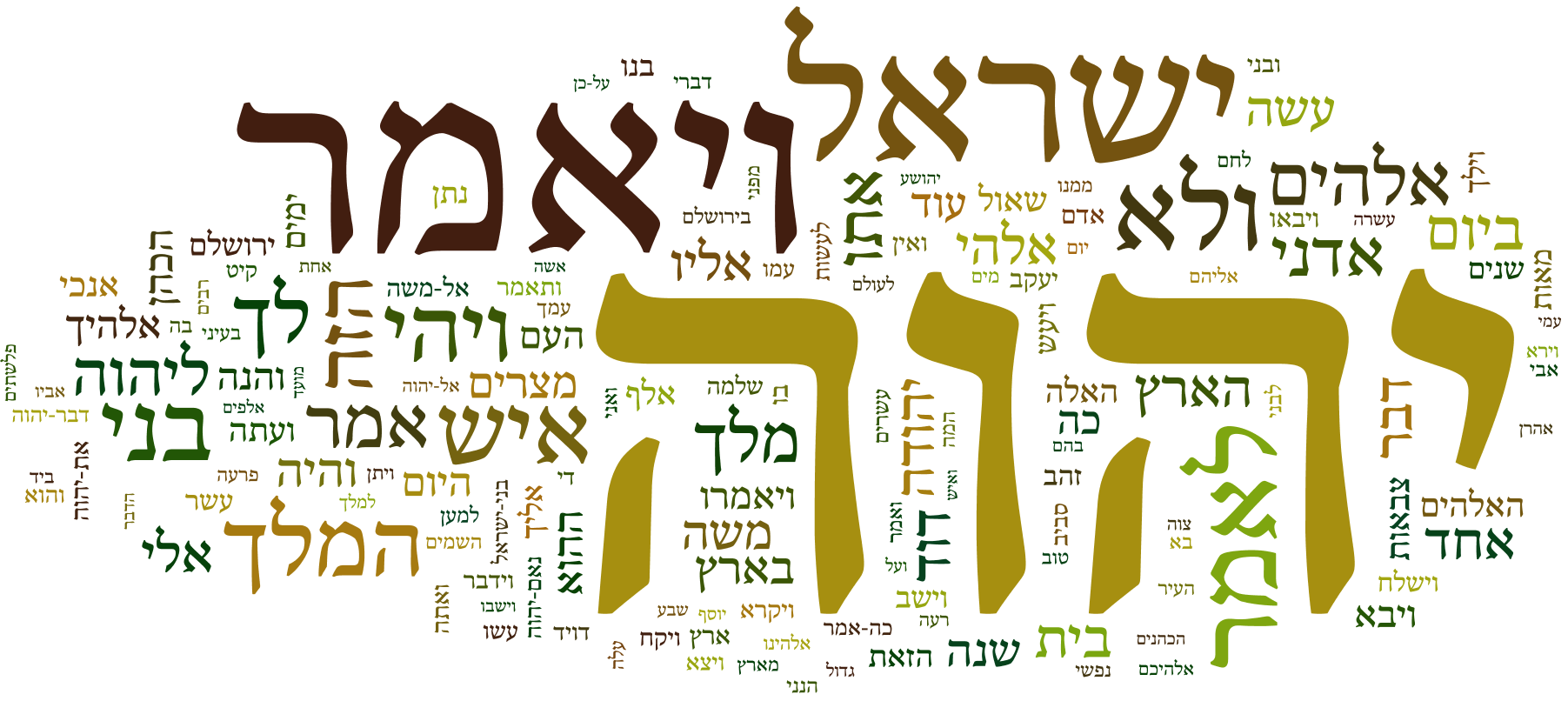
A word cloud of the Hebrew Bible. (Wiki Commons)
Would you like to know Hebrew?  You may be surprised to discover how many Hebrew words you already do know, such as halleluyah, amen, and shalom.
................................................................................................................................................

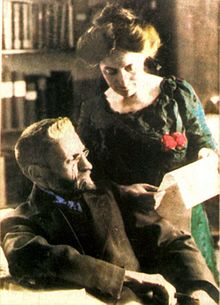
Eliezer Ben-Yehuda and wife
The Man and the Miracle that Revived Hebrew: 
Eliezer Ben-Yehuda
.
A Jewish man reads the TorahHebrew has against all odds defied extinction. The fact that it’s now a modern language used daily by more than seven million people in Israel and in Jewish communities around the world is an absolute miracle. Believers who learn Hebrew today are doing far more than simply learning another language; they are participating in a great end-time move of the Spirit of God, reconnecting the Church to its Jewish roots, and revealing the true identity of HaMashiach (the Messiah)—Yeshua.
Bibles For Israel


“For out of Zion shall go forth the Torah and the Word of LORD (YHVH)
from Jerusalem.”
 
- Isaiah 2:3


Let’s take a brief look at what these three words really mean and discover the man and the miracle that has revived the Hebrew language around the world after 2,000 years of linguistic exile.
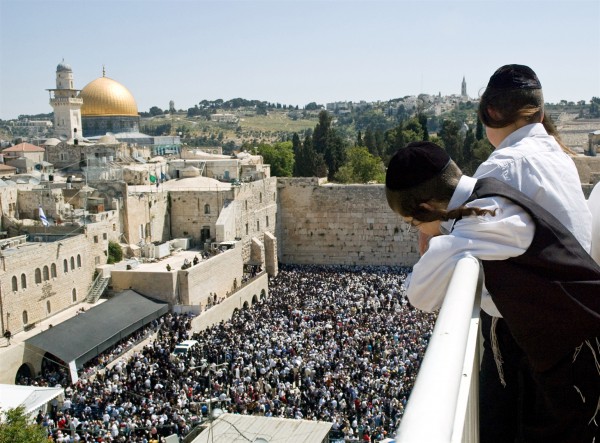
Kotel-crowded
Orthodox Jewish children watch as Israelis
 gather at the Western (Wailing) Wall for prayer.
Halleluyah actually consists of two Hebrew words: hallelu, meaning praise (a plural imperative) and Yah (shortened form of Yahweh, the personal name for God and often written as LORD)
Amen, a Hebrew word commonly said in prayer means dependable, faithful, certain and true. 
This word has the connotation of faith, since its root A-M-N can mean faithful, have faith, believe, reliable, confirmed, and to be firm.
Amen is often translated as truly or verily in the Brit Chadashah (New Testament), which we will see later is quite Hebraic.
“In that day you will not question Me about anything. Truly, truly, (amen, amen) I say to you, if you ask the Father for anything in My name, He will give it to you.” (John 16:23)
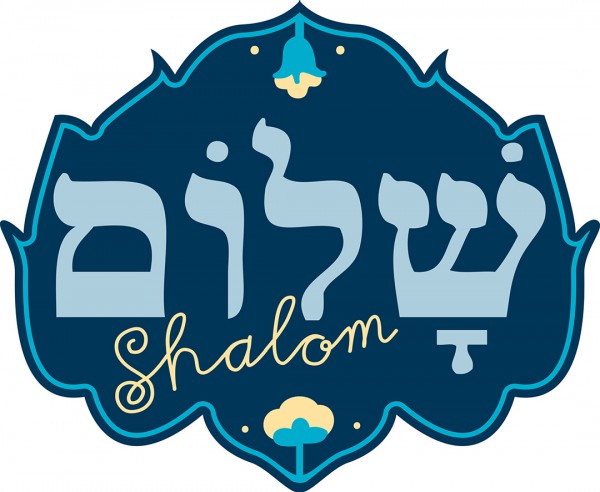
The Hebrew word Shalom, read from right to left.
And, of course, people around the globe know the Hebrew word shalom, but not many know that it means much more than peace. 
It encompasses wholeness, blessing, and well-being. It is also used conversationally to greet others hello and goodbye.
The Miracle of the Survival of Hebrew
The fact that it’s now a modern language used daily by more than seven million people in Israel and in Jewish communities around the world is an absolute miracle.
Logically, Hebrew should have died out two millennia ago after Rome destroyed Jerusalem in AD 70 and defeated the Bar Kokhba revolt in 135, resulting in the scattering (Diaspora) of God’s Chosen People to lands near and far.
In the Diaspora, the Jewish People acquired the local language for everyday use.
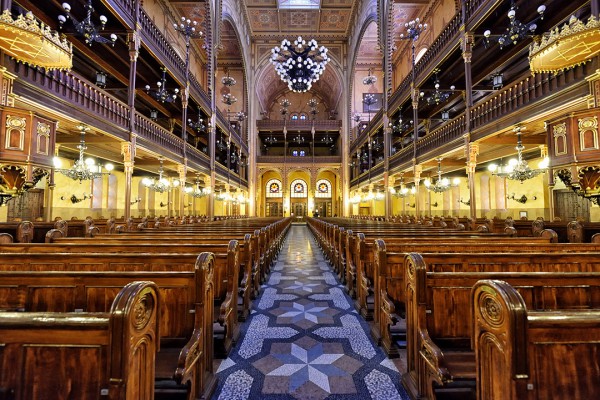
Great Synagogue Budapest Hungary, Dohany Street Synagogue
The Great Synagogue on Dohány Street in Budapest, Hungary
 is the largest synagogue in Europe and one of the
largest in the world. It seats 3,000 people.
But Hebrew didn’t completely fade away; it survived primarily in the synagogues and yeshivas (Jewish seminaries) as a scholarly and liturgical language.
While noticeable differences between Ancient and Modern Hebrew exist, they are not drastic.
In fact, if Moses were to return today, he would likely understand modern Hebrew, though he would have to learn some new words as well as adjust to some differences in syntax (arrangement of words to form a sentence).
Some of these syntax changes are due to the influence of Yiddish, a combination of German, Hebrew, Slavic, and other European dialects that became the spoken vernacular of Ashkenazi Jews in central and eastern Europe beginning in the ninth century.
And, of course, many words had to be introduced to accommodate technical and cultural innovations.

Eliezer Ben-Yehuda: Father of Modern Hebrew
Jewish-reads-prayer-holy-book-Western-Wailing-Wall
A Jewish man reads at the Western Wall in Jerusalem.
Throughout the Tanakh (Old Testament), we see men of courage leading the Jewish People out of their exile and into their destiny: God used Moses to bring the children of Israel out of slavery into freedom. 
He used Joshua to bring them out of the wilderness into the Promised Land. 
And He used Cyrus to bring them out of Babylon and even help them rebuild the Temple.
The movement of Jews back to the Biblical land of Israel in the last two centuries required many such courageous partners and visionaries.
In the area of language, God used a man named Eliezer Ben-Yehuda to help teach the Jewish People leaving the Diaspora how to speak Hebrew again in modern pre-state Israel, a move of God that was prophesied 2,700 years ago:
“Do not fear, for I am with you; I will bring your offspring from the east, and gather you from the west. I will say to the north, ‘Give them up!’ and to the south, ‘Do not hold them back.’ Bring My sons from afar and My daughters from the ends of the earth.” (Isaiah 43:6)
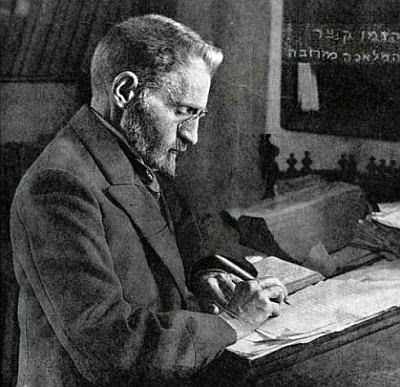
Eliezer Ben_Yehuda
Eliezer Ben_Yehuda
Ben-Yehuda, whose name means son of Judah, was born Eliezer Yitzhak Perlman in Luzhki, located in the former Soviet territory and modern nation of Belarus.
He believed that the revival of the Hebrew language in the Land of Israel could be the key to uniting the scattered Jews. 
Eliezer Ben-Yehuda and wife
Eliezer Ben-Yehuda and wifeBen-Yehuda
 and his wife Hemda, 1912
As such, he rejected the Diaspora lifestyle, including the speaking of Yiddish and other regional dialects.
Making aliyah (immigrating) to the Promised Land in 1881 at the age of 23, he set out to revive Hebrew as the native tongue for future generations of Jewish olim (immigrants).
History has proved his strategy to be successful.
Ben-Yehuda: Radical Approach to Reviving Hebrew
Eliezer Ben-Yehuda took a radical approach to his mission:  some might even say fanatical!
He insisted that only Hebrew be spoken in his home. 
He is even reported to have admonished his wife after hearing her sing a Russian lullaby to their child.
The first native speaker of Modern Hebrew was his son, Ben-Zion (Zion’s son), who also was only allowed to speak Hebrew.
Yarkon Park in Tel Aviv, Israel
Yarkon Park, Tel Aviv: In 1909, the first Hebrew city, Tel Aviv, 
was founded. Hebrew so dominated the scene here by this time
 that one writer announced in 1913: “Yiddish is more treif 
(non-kosher) than pork. To speak it a person needs great courage.”
His extreme efforts paid off.
By setting an example in his own family and taking students into his home to learn Hebrew, along with the help of others passionate for the cause of national unity, he helped to start a linguistic revival.
The Development of Modern Hebrew
Ben-Yehuda’s deep calling and conviction caused him to push forward even amid ultra-religious Jews who accused him and his work of being blasphemous.
After millennia of isolated use, Hebrew had been viewed by these Orthodox Jews as the one and only Holy Language, which should be spoken only during prayer and in the synagogue.
Through one of the newspapers that he edited, Ha-Zvi, Ben-Yehuda not only promoted his edgy Hebrew vernacular, he waged war against certain religious practices and customs in the Land, which led to his arrest and the closing of the paper for fourteen months in 1894. (National Library of Israel)
The Orthodox community even declared Ben-Yehuda herem (excommunicated), but he did not waiver. (My Jewish Learning)
In 1890, he established the Hebrew Language Committee (Va’ad ha-lashon ha-Ivrit). 
The Committee set out to establish uniform standards in grammar, terminology, and pronunciation that would be used throughout schools, commerce, and government.
It published bulletins and dictionaries and established thousands of Hebrew words that are in everyday use today. 
Eliezer_Ben-Yehuda_at_his_desk_in_Jerusalem_-_c1912
Ben-Yehuda’s English–Hebrew / Hebrew–English Dictionary is still one of the most commonly used dictionaries.
Ben-Yehuda, who immigrated a year before the First Aliyah movement (1882–1903), saw the fruit of his efforts in the Second Aliyah (1904-1914). 
In this movement, 35,000 olim (immigrants), mostly from Russia, entered the Ottoman-ruled land of pre-state Israel and many embraced Hebrew as their new spoken and written language.
In 1922, with the region now under control of the British Mandate of Palestine, Ben-Yehuda and his supporters crossed a great milestone — the formal declaration of Hebrew as one of the land’s three official languages, alongside English and Arabic.
Near the end of that year, on December 16th, Ben-Yehuda died at age 64 of tuberculosis, a sickness he suffered from for most of his life.
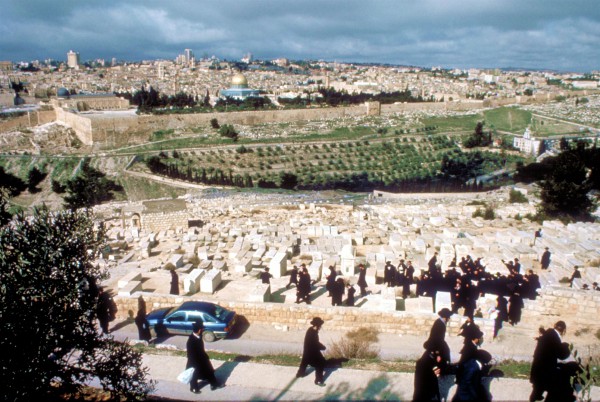
A view of the Temple Mount from the Mount of Olives
Nearly 150,000 cemetery plots line the western slope of the
Mount of Olives, facing the Temple Mount platform.
Such was the honor and respect that the Israeli people had for him that 30,000 people attended his funeral. He was buried on the Mount of Olives in Jerusalem.
A view of the Temple Mount from the Mount of Olives
To honor Ben-Yehuda, large Israeli cities often have a street named after him. 
In fact, the most famous and busy streets in both Jerusalem and Tel Aviv are named Ben Yehuda Street.
In the book Was Hebrew Ever a Dead Language?, Cecil Roth succinctly summarized Ben-Yehuda’s contribution this way:  “Before Ben-Yehuda, Jews speak Hebrew; after him, they did.”
Just five years after the Modern State of Israel was reborn in 1948, the Israeli government replaced The Hebrew Language Committee with the Academy of the Hebrew Language, which operates out of Hebrew University in Jerusalem.
The Academy continues to create new words from Hebrew root word structures as it replaces loaned words derived from other languages.
It also continues to set standards for Modern Hebrew grammar, orthography, transliteration, and punctuation based on the historical development of the language. 
Though it has been labeled Israel’s “language police,” the Academy considers its decisions binding only on formal speeches and written texts. (Hebrew Academy)
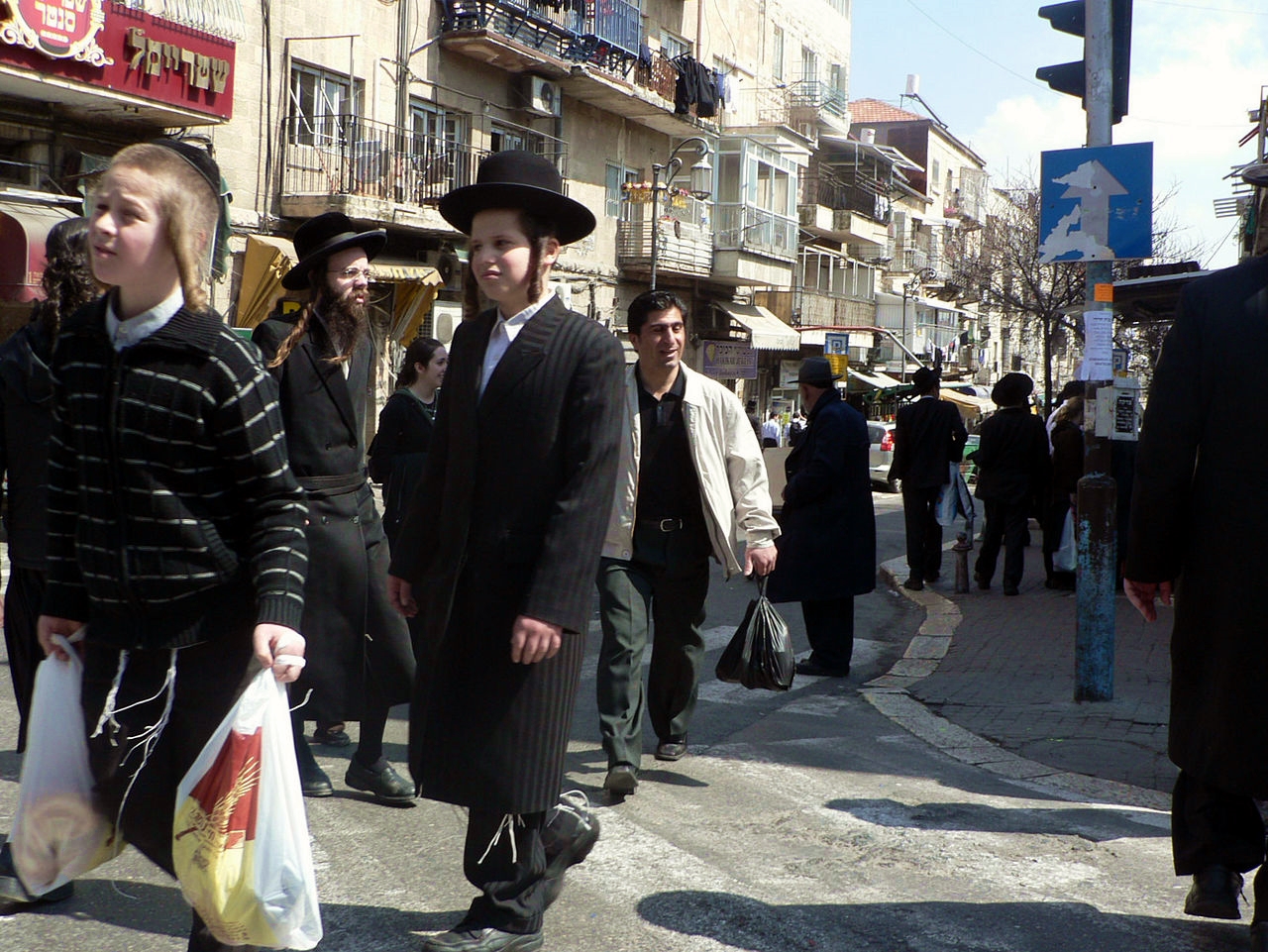
The Mea shearim neighborhood in the heart of Jerusalem.
The Mea Shearim neighborhood in the heart of Jerusalem.
Though Hebrew is now the native tongue of new generations of Israelis and integrated throughout society here, in the ultra-Orthodox religious neighborhood of Mea Shearim in Jerusalem, some still reject Hebrew and use Yiddish for their everyday spoken language. 
Even so, when they pay bills, deal with Israeli companies on the phone, and interact with the larger society, they do have to speak Hebrew.
The Hebrew Bible
While Aramaic was at one time the common language of the Israeli people, including Yeshua (Jesus), it accounts for less than one percent of the Tanakh (Old Testament), which was written primarily in Hebrew.
Out of the over 23,000 verses in the Tanakh, only 250 are written in Aramaic. We find Aramaic, for example, in Ezra 4:8–6:18 and 7:12–26, Daniel 2:4b–7:28, and Jeremiah 10:11.
And although the Brit Chadashah (New Testament) is written primarily in Greek with some Aramaic, it is very Hebraic in nature. 
Why? The writers are Jewish, the culture is Jewish, the religion is Jewish, the traditions are Jewish, and the concepts are Jewish!
The apostle Paul who wrote thirteen of the twenty-seven books of the Brit Chadashah even identified himself as being “circumcised on the eighth day, of the people of Israel, of the tribe of Benjamin, a Hebrew of Hebrews; as to the law, a Pharisee.”  (Philippians 3:5)
A Jewish man reads the TorahBecause of the strong Jewish identity of its writers, we find throughout the Brit Chadashah numerous references to the prophecies and practices of the Hebrew Scriptures.
For that reason alone, learning Hebrew helps us to better understand the true plans and purposes of God.
A Jewish man reads the TorahRoy Blizzard, Jr. in Understanding the Difficult Words of Jesus said,
“If any additional advances are to be made, especially in better-understanding the words of Jesus, the concentration must shift to the study of Hebrew history and culture, and above all, the Hebrew language.”
Believers who learn Hebrew today are doing far more than simply learning another language; they are participating in a great end-time move of the Spirit of God, reconnecting the Church to its Jewish roots, and revealing the true identity of HaMashiach (the Messiah)—Yeshua.
“For out of Zion shall go forth the Torah and the Word of LORD (YHVH)
from Jerusalem.”
 
- Isaiah 2:3

First and foremost, our mission is ministering to Jewish people with love and comfort.
“Comfort, comfort my people (Israel), says your God.” Isaiah 40
Located in the Holy Land, the Bibles For Israel ministry is producing the first-ever Messianic Prophecy Bible.  
We educate Jewish people on the prophecies about the Messiah in the Tanakh (Hebrew Scriptures), showing the truths by defining the Messianic and rabbinical points of view.
Not only are we creating the free Messianic Prophecy Bible in print form, we are tirelessly working on the creation of free Bible software for mobile and computer devices. 
This free software will be used by everyone – from seminary students to Sunday school children in African villages,  and those who are scattered around the four corners of the earth.
Our Bible will reach millions of people in hundreds of languages, spanning all 257 countries and territories in the world.
We also minister to the spiritual and financial needs of the elderly, poor, and single parents. 
Jewish-reads-prayer-holy-book-Western-Wailing-Wall