Showing posts with label Cubit. Show all posts

Wednesday, December 23, 2020

BIBLICAL VALUE FOR PI - Does the Bible Contain a Mathematically Incorrect Value for "Pi"? Construction techniques in those days were surprisingly advanced. We can assume that their mathematics was precise and measurements handled with care. Properly understood, the Bible is not only correct, it foreshadows modern engineering truth. Does the Bible contain errors in math? If it does, this calls into question its moral and spiritual authority. Much is at stake. Let's carefully examine one of the most frequent charges of error. When describing Solomon's Temple and its fixtures, Scripture tells of a great basin cast of molten brass "ten cubits from the one brim to the other: it was round all about, . . . and a line of thirty cubits did compass it round about." The circumference, c, of a circle is related to its diameter, d, by the ratio "pi" or "P" according to the equation c = Pd. Mathematical derivatives have calculated the precise value of P to many decimal places, but for most applications the approximation 3.14 is sufficient. Inserting the value of circumference and diameter given by Scripture into the equation yields a value of P to be 3, and it is this apparent error which gives Bible detractors such glee. Construction techniques in those days were surprisingly advanced. We can assume that their mathematics was precise and measurements handled with care. Notice that the basin "was an hand breadth thick, and the brim thereof was wrought like the brim of a cup, with flowers of lilies".

......................................................................................................................................................................................................................................................

 Biblical Value for Pi

Does the Bible Contain a Mathematically Incorrect Value for "Pi"?

.

Construction techniques in those days were surprisingly advanced. We can assume that their mathematics was precise and measurements handled with care. Properly understood, the Bible is not only correct, it foreshadows modern engineering truth.

BY JOHN D. MORRIS, PH.D. 

The Institute for Creation Research ICR


Does the Bible contain errors in math?

If it does, this calls into question its moral and spiritual authority. Much is at stake.

Let's carefully examine one of the most frequent charges of error.

When describing Solomon's Temple and its fixtures, Scripture tells of a great basin cast of molten brass "ten cubits from the one brim to the other: it was round all about, . . . and a line of thirty cubits did compass it round about" (I Kings 7:23).

The circumference, c, of a circle is related to its diameter, d, by the ratio "pi" or "P" according to the equation c = Pd.

Mathematical derivatives have calculated the precise value of P to many decimal places, but for most applications the approximation 3.14 is sufficient.

Inserting the value of circumference and diameter given by Scripture into the equation yields a value of P to be 3, and it is this apparent error which gives Bible detractors such glee.

Construction techniques in those days were surprisingly advanced.

We can assume that their mathematics was precise and measurements handled with care.

Notice that the basin "was an hand breadth thick, and the brim thereof was wrought like the brim of a cup, with flowers of lilies" (verse 26).

A "hand breadth" is an inexact distance of about four inches, but sufficient for this general description.

The whole basin flared out at the top, much like a lily. So, exactly what do the dimensions given really represent?

The diameter of the basin would be the inside diameter, measured from side to side.

But the circumference would be measured by placing a cord around the outside, then measuring the length of the cord.

Furthermore, at what elevation along the tapered basin was the measurement taken?

Obviously, these are not intended to be precise, but to give the overall impression of great size and beauty.

Engineers have adopted a technique to insure that reported measurements are properly understood.

To do this they use the convention called "significant figures."

The number 10 is quite different from the number 10.0 or 10.00 in the precision it implies.

To an engineer the number 10 can actually mean anything between 9.5 and 10.5.

Likewise, the number 30 can actually mean anything between 29.5 and 30.5.

While the number P is accurate to many decimal places, the other two numbers do not have this precision.

When one precise number is multiplied by an imprecise number, the product should be reported with no more precision than the least precise factor.

Multiplying the diameter, 10 (i.e., 9.5 to 10.5) by P, is properly understood as implying a circumference somewhere between 29.8 and 33.0.

When constructing an object for which extremely high precision is needed (e.g., the space shuttle), numbers are designed, reported, and fabricated to several decimal places, but to expect such precision in a lay description of this huge basin cast from molten brass is not only improper, it shows lack of understanding of basic engineering concepts.

Properly understood, the Bible is not only correct, it foreshadows modern engineering truth.

The Institute for Creation Research (ICR) wants people to know that God’s Word can be trusted in everything it speaks about—from how and why we were made, to how the universe was formed, to how we can know God and receive all He has planned for us.

After 50 years of ministry, ICR remains a leader in scientific research within the context of biblical creation. Founded by Dr. Henry Morris in 1970, ICR exists to conduct scientific research within the realms of origins and Earth history, and then to educate the public both formally and informally through professional training programs, through conferences and seminars around the country, and through books, magazines, and media presentations.

https://www.icr.org/article/does-bible-contain-mathematically-incorrect-value-/


You might also like:


Does the Bible say pi equals 3.0?

CLICK HERE . . . to view . . . 

https://puricarechronicles.blogspot.com/2020/08/does-bible-say-pi-equals-30-bible-does.html

..................................................................................................................................................................................................................................................................

Pi - The Most Important Number in the Universe

CLICK HERE . . . to view . . . 

https://puricare.blogspot.com/2019/02/pi-most-important-number-in-universe.html

..................................................................................................................................................................................................................................................................

How to Calculate Tire Turns Per Mile

CLICK HERE . . . to view . . . 

https://puricare.blogspot.com/2020/07/how-to-calculate-tire-turns-per-mile.html

Monday, August 31, 2020

DOES THE BIBLE SAY PI EQUALS 3.0? - The Bible does not defy geometry with regard to the value of pi, and in particular it does not say that pi equals 3.0. Skeptics who allege an inaccuracy are wrong, because they fail to take into account all the data. The Bible is reliable, and seeming discrepancies vanish on closer examination. In 1 Kings 7:23 there is an intriguing statement: ‘And he [Hiram on behalf of King Solomon] made a molten sea, ten cubits from the one brim to the other: it was round all about, and his height was five cubits: and a line of thirty cubits did compass it round about.’ A similar account is given in the parallel passage in 2 Chronicles 4:2. From time to time sceptics have used these verses to ridicule the accuracy of the Bible by claiming that, if one uses the figures stated, the circumference of the vessel divided by its diameter gives 3.0, instead of the value pi π, 3.14159…). Closer examination shows there are at least two possible explanations. The first concerns the meaning of the word cubit, and how it would have been used in measuring the vessel. A cubit was the length of a man’s forearm from the elbow to the extended fingertips. The Hebrew cubit was about 45 centimetres (18 inches). The Bible does not defy geometry with regard to the value of pi, and in particular it does not say that pi equals 3.0. The Bible is reliable, and seeming discrepancies vanish on closer examination.

Historical Length or Distance | SpringerLink
.............................................................................................................................................................
Does the Bible Teach that Pi = 3? : Strange NotionsDoes the Bible say pi equals 3.0?
.
Stay solid: Join the movement to add 'e' to Pi Day| Commentary | Pizza  MarketplaceThe Bible does not defy geometry with regard to the value of pi, and in particular it does not say that pi equals 3.0. Skeptics who allege an inaccuracy are wrong, because they fail to take into account all the data. The Bible is reliable, and seeming discrepancies vanish on closer examination.
by Russell Grigg


In 1 Kings 7:23 there is an intriguing statement: ‘And he [Hiram on behalf of King Solomon] made a molten sea, ten cubits from the one brim to the other: it was round all about, and his height was five cubits: and a line of thirty cubits did compass it round about.’ 
Διακόσμηση Φροντιστηρίων - Αυτοκόλλητο Τοίχου "π"  Wallsticker pi - Math decalsA similar account is given in the parallel passage in 2 Chronicles 4:2.
From time to time sceptics have used these verses to ridicule the accuracy of the Bible by claiming that, if one uses the figures stated, the circumference of the vessel divided by its diameter gives 3.0, instead of the value pi π, 3.14159…).1
Closer examination shows there are at least two possible explanations.
1.The first concerns the meaning of the word cubit, and how it would have been used in measuring the vessel.
A cubit was the length of a man’s forearm from the elbow to the extended fingertips.
The Hebrew cubit was about 45 centimetres (18 inches).
It is obvious that a man’ forearm does not readily lend itself to the measurement of fractions of a forearm.
In the Bible half a cubit is mentioned several times, but there is no mention of a third part of a cubit or a fourth part of a cubit, even though these fractions of ‘a third part’ and ‘a fourth part’ were used in volume and weight measurements.2 
It therefore seems highly probable that any measurement of more than half a cubit would have been counted as a full cubit, and any measurement of less than half a cubit would have been rounded down to the nearest full cubit.
What Is Pi? | Live ScienceFrom 1 Kings 7:23 (‘a line of thirty cubits did compass it round about’), it appears that the circumference was measured with ‘a line’, i.e. a piece of string or cord on which the distance was marked, and this length would then have been measured off in cubits by the measurer, using his own or someone else’s forearm, or possibly a cubit-long rod.
Similarly, the diameter would have been marked on a line and ‘cubitized’ in the same way.
If the actual diameter was 9.65 cubits, for example, this would have been reckoned as 10 cubits.
The actual circumference would then have been 30.32 cubits. This would have been reckoned as 30 cubits (9.6 cubits diameter gives 30.14 circumference, and so on).
The ratio of true circumference to true diameter would then have been 30.32÷ 9.65 = 3.14, the true value for pi, even though the measured value (i.e. to the nearest cubit) was 30 ÷ 10 = 3.
While the above seems reasonable, and the Ask ‘Dr Math’ Forum agrees that there is no error in the Bible here, we have no way of knowing for certain whether the measurements were approximated in this way.
However, even if it is assumed that the measurements given were precisely 10 and 30 cubits, the following appears to provide a definitive answer.
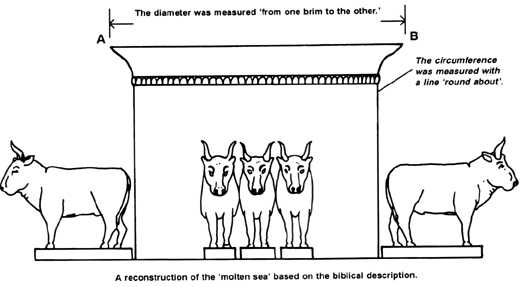
2.Verse 26 of 1 Kings 7 says that the vessel in question had a brim which ‘was wrought like the brim of a cup, with flowers of lilies’ (KJV), or a rim ‘like the rim of a cup, like a lily blossom’ (NIV), i.e. the brim or rim turned outward, suggesting the curvature of a lily.3 
It is believed by Bible scholars to have looked like the drawing below.4

Let us consider the details given in 1 Kings 7:23 and 2 Chronicles 4:2. These are:
1.The diameter of 10 cubits was measured ‘from brim to brim’ (verse 23), i.e. from the topmost point of the brim on one side to the topmost point of the brim on the other side (points A and B in the diagram).
2.The circumference of 30 cubits was measured with a line, ‘round about’ (verse 23), i.e. the most natural meaning of these words is that they refer to the circumference of the outside of the main body of the tank, measured by a string pulled tightly around the vessel below the brim.
Does the Bible Teach that Pi = 3? : Strange NotionsIt is very obvious that the diameter of the main body of the tank was less than the diameter of the top of the brim.
And it is also obvious that the circumference of 30 cubits could have been measured at any point down the vertical sides of the vessel, below the brim.
For a measured circumference of 30 cubits, we can calculate what the external diameter of the vessel would have been at that point from the formula:
diameter =
circumference ÷ pi
=
30 cubits ÷ 3.14
=
9.55 cubits.
Thus, the external diameter of the vessel at the point where the circumference was measured must have been 9.55 cubits.5
It is thus abundantly clear that the Bible does not defy geometry with regard to the value of pi, and in particular it does not say that pi equals 3.0. 
.
Skeptics who allege an inaccuracy are wrong, because they fail to take into account all the data.
The Bible is reliable, and seeming discrepancies vanish on closer examination.
References and notes
1.     Pi, or the ratio of the circumference of a circle to its diameter, is what has been known as an irrational number or infinite non-repeating decimal, of which the first digits are 3.1415926536 …. A value of 3.14 is close enough for our purposes. Return to text.
2.     Abingdon’s Strong’s Exhaustive Concordance of the Bible. Return to text.
3.     The International Standard Bible Encyclopedia 4:368, Eerdmans, Grand Rapids (Michigan), 1988. Return to text.
4.     Adapted from reference 3. An NIV footnote (not part of the inspired text) to 1 Kings 7:26 suggests that the vessel had a greater volume than the above figures allow. This could indicate that the vessel may have been shaped more like a lily than imagined (i.e. part of it may have been bulbous), or that the conversion factor used by the NIV commentator was incorrect. Return to text.
5.     Some have suggested that there is one other explanation that fits all the dimensions given in the biblical text, if the circumference measured refers to the inside of the vessel. (This is a possibility, although, as already stated, it was most likely the external circumference which was measured.) The diameter was 10 cubits or 4.50 metres, the circumference was 30 cubits or 13.50 metres, and the walls were ‘a hand breadth thick’ (verse 26) or 10 centimetres (to the nearest centimetre).6 If the diameter of 4.50 metres was the outside measurement, we subtract 10 centimetres x 2 (to allow for the thickness of the wall on either side) to arrive at a figure of 4.30 metres for the internal diameter of the vessel, and we can now calculate the internal circumference using the formula:
circumference = diameter

= 4.3 metres x 3.14
= 13.50 metres
= 30 cubits
which is exactly the figure given in 1 Kings 7:23. But as shown, there is no need to resort to this solution. Return to text.
6.     The New Encyclopædia Britannica, Vol. 5, p.677, 1992. Return to text.

Russell M. Grigg M.Sc. (Hons.)
Creationist Chemist and Missionary
CMI–Australia
Biography
Russell Grigg was born in Auckland, New Zealand, in 1927. He received his schooling and university education in that country. He studied chemistry at Victoria University College, Wellington (now known as Victoria University of Wellington), graduating in 1948. He then worked for a number of years as an industrial chemist and then as a manager in the paint manufacturing industry in Wellington and Christchurch.
After theological studies at the New Zealand Bible Training Institute (later known as the Bible College of New Zealand, and now as Laidlaw College), he joined the Overseas Missionary Fellowship in 1959. He served for 12 years, heading up OMF’s publishing program in Jakarta, Indonesia. Here he met and married Miss Merle Cornelius, another member of OMF, from Adelaide, Australia. Merle went to be with the Lord in January 2009. Russell has three adult children and nine grandchildren.
In 1971, the family settled in Adelaide and Russell worked for 10 years with Rigby Ltd., an Australian publishing company, rising to be one of the Senior Editors. Here he wrote two books, Australian Trains and Death in the Family: What to Do, both published by Rigby Ltd.
In 1982, Russell rejoined OMF and served on the home staff for eight years. He was State Director for South Australia.
50 Fascinating Pi Facts and History | FactRetriever.com
Who Wants Some Pi? – Martin WickensIt's Pi Day! Let's have some pie. - CSMonitor.comLight for your path / Real Issues...Plus