Showing posts with label Diaspora. Show all posts

Saturday, June 27, 2020

THE MAN AND THE MIRACLE THAT REVIVED HEBREW: Eliezer Ben-Yehuda - Hebrew has against all odds defied extinction. The fact that it’s now a modern language used daily by more than seven million people in Israel and in Jewish communities around the world is an absolute miracle. Believers who learn Hebrew today are doing far more than simply learning another language; they are participating in a great end-time move of the Spirit of God, reconnecting the Church to its Jewish roots, and revealing the true identity of HaMashiach (the Messiah)—Yeshua. Hebrew has against all odds defied extinction. Hebrew should have died out two millennia ago after Rome destroyed Jerusalem in AD 70 and defeated the Bar Kokhba revolt in 135, resulting in the scattering (Diaspora) of God’s Chosen People to lands near and far. In the Diaspora, the Jewish People acquired the local language for everyday use. But Hebrew didn’t completely fade away; it survived primarily in the synagogues and yeshivas (Jewish seminaries) as a scholarly and liturgical language. While noticeable differences between Ancient and Modern Hebrew exist, they are not drastic. In fact, if Moses were to return today, he would likely understand modern Hebrew, though he would have to learn some new words as well as adjust to some differences in syntax (arrangement of words to form a sentence). “For out of Zion shall go forth the Torah and the Word of LORD (YHVH) from Jerusalem.” - Isaiah 2:3

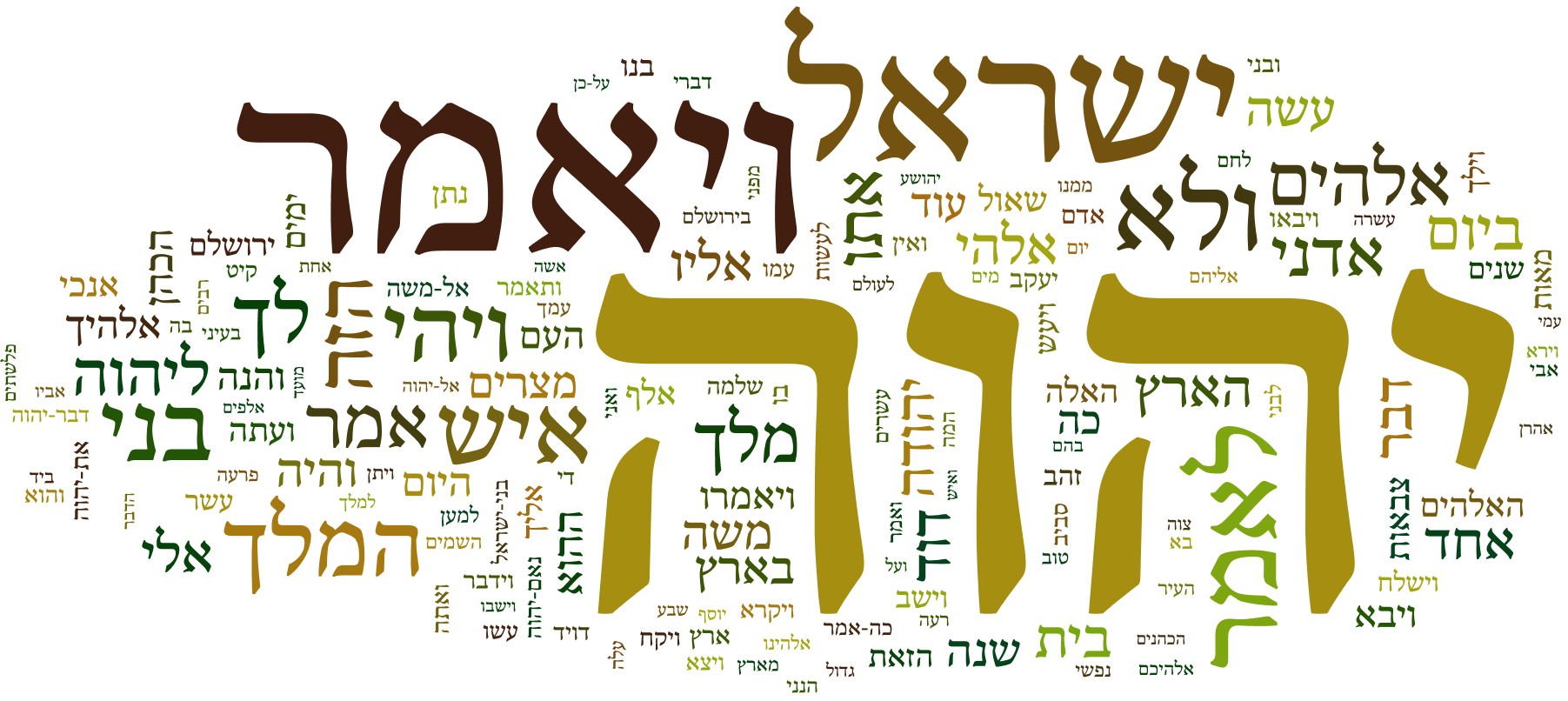
A word cloud of the Hebrew Bible. (Wiki Commons)
Would you like to know Hebrew?  You may be surprised to discover how many Hebrew words you already do know, such as halleluyah, amen, and shalom.
................................................................................................................................................

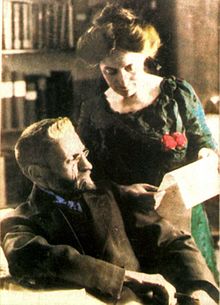
Eliezer Ben-Yehuda and wife
The Man and the Miracle that Revived Hebrew: 
Eliezer Ben-Yehuda
.
A Jewish man reads the TorahHebrew has against all odds defied extinction. The fact that it’s now a modern language used daily by more than seven million people in Israel and in Jewish communities around the world is an absolute miracle. Believers who learn Hebrew today are doing far more than simply learning another language; they are participating in a great end-time move of the Spirit of God, reconnecting the Church to its Jewish roots, and revealing the true identity of HaMashiach (the Messiah)—Yeshua.
Bibles For Israel


“For out of Zion shall go forth the Torah and the Word of LORD (YHVH)
from Jerusalem.”
 
- Isaiah 2:3


Let’s take a brief look at what these three words really mean and discover the man and the miracle that has revived the Hebrew language around the world after 2,000 years of linguistic exile.
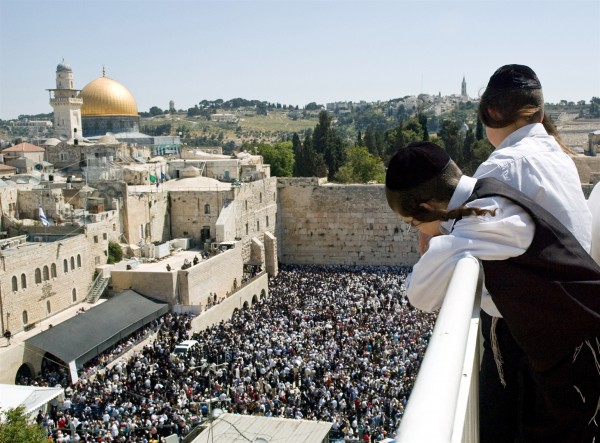
Kotel-crowded
Orthodox Jewish children watch as Israelis
 gather at the Western (Wailing) Wall for prayer.
Halleluyah actually consists of two Hebrew words: hallelu, meaning praise (a plural imperative) and Yah (shortened form of Yahweh, the personal name for God and often written as LORD)
Amen, a Hebrew word commonly said in prayer means dependable, faithful, certain and true. 
This word has the connotation of faith, since its root A-M-N can mean faithful, have faith, believe, reliable, confirmed, and to be firm.
Amen is often translated as truly or verily in the Brit Chadashah (New Testament), which we will see later is quite Hebraic.
“In that day you will not question Me about anything. Truly, truly, (amen, amen) I say to you, if you ask the Father for anything in My name, He will give it to you.” (John 16:23)
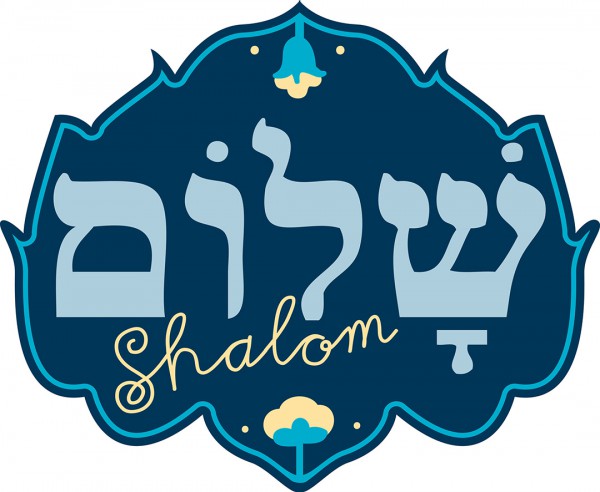
The Hebrew word Shalom, read from right to left.
And, of course, people around the globe know the Hebrew word shalom, but not many know that it means much more than peace. 
It encompasses wholeness, blessing, and well-being. It is also used conversationally to greet others hello and goodbye.
The Miracle of the Survival of Hebrew
The fact that it’s now a modern language used daily by more than seven million people in Israel and in Jewish communities around the world is an absolute miracle.
Logically, Hebrew should have died out two millennia ago after Rome destroyed Jerusalem in AD 70 and defeated the Bar Kokhba revolt in 135, resulting in the scattering (Diaspora) of God’s Chosen People to lands near and far.
In the Diaspora, the Jewish People acquired the local language for everyday use.
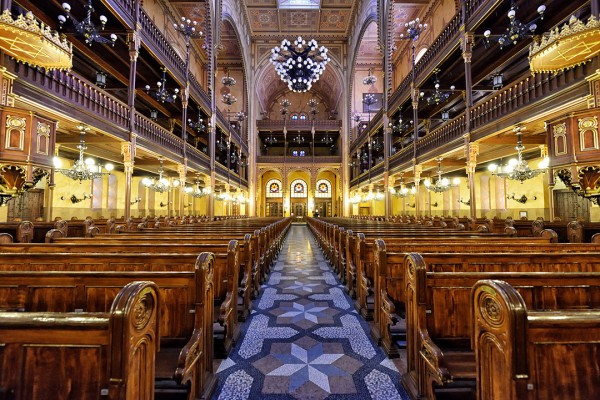
Great Synagogue Budapest Hungary, Dohany Street Synagogue
The Great Synagogue on Dohány Street in Budapest, Hungary
 is the largest synagogue in Europe and one of the
largest in the world. It seats 3,000 people.
But Hebrew didn’t completely fade away; it survived primarily in the synagogues and yeshivas (Jewish seminaries) as a scholarly and liturgical language.
While noticeable differences between Ancient and Modern Hebrew exist, they are not drastic.
In fact, if Moses were to return today, he would likely understand modern Hebrew, though he would have to learn some new words as well as adjust to some differences in syntax (arrangement of words to form a sentence).
Some of these syntax changes are due to the influence of Yiddish, a combination of German, Hebrew, Slavic, and other European dialects that became the spoken vernacular of Ashkenazi Jews in central and eastern Europe beginning in the ninth century.
And, of course, many words had to be introduced to accommodate technical and cultural innovations.

Eliezer Ben-Yehuda: Father of Modern Hebrew
Jewish-reads-prayer-holy-book-Western-Wailing-Wall
A Jewish man reads at the Western Wall in Jerusalem.
Throughout the Tanakh (Old Testament), we see men of courage leading the Jewish People out of their exile and into their destiny: God used Moses to bring the children of Israel out of slavery into freedom. 
He used Joshua to bring them out of the wilderness into the Promised Land. 
And He used Cyrus to bring them out of Babylon and even help them rebuild the Temple.
The movement of Jews back to the Biblical land of Israel in the last two centuries required many such courageous partners and visionaries.
In the area of language, God used a man named Eliezer Ben-Yehuda to help teach the Jewish People leaving the Diaspora how to speak Hebrew again in modern pre-state Israel, a move of God that was prophesied 2,700 years ago:
“Do not fear, for I am with you; I will bring your offspring from the east, and gather you from the west. I will say to the north, ‘Give them up!’ and to the south, ‘Do not hold them back.’ Bring My sons from afar and My daughters from the ends of the earth.” (Isaiah 43:6)
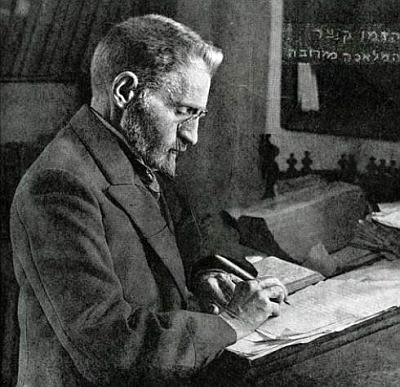
Eliezer Ben_Yehuda
Eliezer Ben_Yehuda
Ben-Yehuda, whose name means son of Judah, was born Eliezer Yitzhak Perlman in Luzhki, located in the former Soviet territory and modern nation of Belarus.
He believed that the revival of the Hebrew language in the Land of Israel could be the key to uniting the scattered Jews. 
Eliezer Ben-Yehuda and wife
Eliezer Ben-Yehuda and wifeBen-Yehuda
 and his wife Hemda, 1912
As such, he rejected the Diaspora lifestyle, including the speaking of Yiddish and other regional dialects.
Making aliyah (immigrating) to the Promised Land in 1881 at the age of 23, he set out to revive Hebrew as the native tongue for future generations of Jewish olim (immigrants).
History has proved his strategy to be successful.
Ben-Yehuda: Radical Approach to Reviving Hebrew
Eliezer Ben-Yehuda took a radical approach to his mission:  some might even say fanatical!
He insisted that only Hebrew be spoken in his home. 
He is even reported to have admonished his wife after hearing her sing a Russian lullaby to their child.
The first native speaker of Modern Hebrew was his son, Ben-Zion (Zion’s son), who also was only allowed to speak Hebrew.
Yarkon Park in Tel Aviv, Israel
Yarkon Park, Tel Aviv: In 1909, the first Hebrew city, Tel Aviv, 
was founded. Hebrew so dominated the scene here by this time
 that one writer announced in 1913: “Yiddish is more treif 
(non-kosher) than pork. To speak it a person needs great courage.”
His extreme efforts paid off.
By setting an example in his own family and taking students into his home to learn Hebrew, along with the help of others passionate for the cause of national unity, he helped to start a linguistic revival.
The Development of Modern Hebrew
Ben-Yehuda’s deep calling and conviction caused him to push forward even amid ultra-religious Jews who accused him and his work of being blasphemous.
After millennia of isolated use, Hebrew had been viewed by these Orthodox Jews as the one and only Holy Language, which should be spoken only during prayer and in the synagogue.
Through one of the newspapers that he edited, Ha-Zvi, Ben-Yehuda not only promoted his edgy Hebrew vernacular, he waged war against certain religious practices and customs in the Land, which led to his arrest and the closing of the paper for fourteen months in 1894. (National Library of Israel)
The Orthodox community even declared Ben-Yehuda herem (excommunicated), but he did not waiver. (My Jewish Learning)
In 1890, he established the Hebrew Language Committee (Va’ad ha-lashon ha-Ivrit). 
The Committee set out to establish uniform standards in grammar, terminology, and pronunciation that would be used throughout schools, commerce, and government.
It published bulletins and dictionaries and established thousands of Hebrew words that are in everyday use today. 
Eliezer_Ben-Yehuda_at_his_desk_in_Jerusalem_-_c1912
Ben-Yehuda’s English–Hebrew / Hebrew–English Dictionary is still one of the most commonly used dictionaries.
Ben-Yehuda, who immigrated a year before the First Aliyah movement (1882–1903), saw the fruit of his efforts in the Second Aliyah (1904-1914). 
In this movement, 35,000 olim (immigrants), mostly from Russia, entered the Ottoman-ruled land of pre-state Israel and many embraced Hebrew as their new spoken and written language.
In 1922, with the region now under control of the British Mandate of Palestine, Ben-Yehuda and his supporters crossed a great milestone — the formal declaration of Hebrew as one of the land’s three official languages, alongside English and Arabic.
Near the end of that year, on December 16th, Ben-Yehuda died at age 64 of tuberculosis, a sickness he suffered from for most of his life.
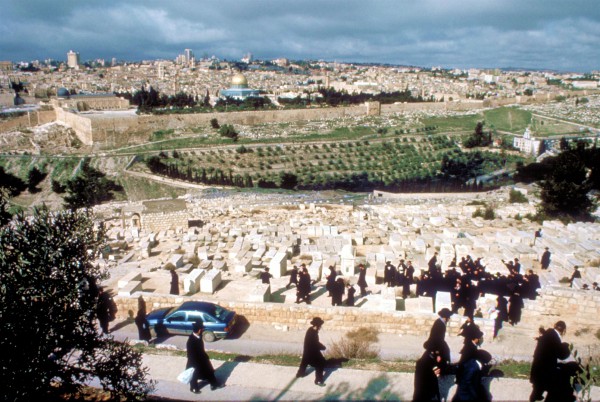
A view of the Temple Mount from the Mount of Olives
Nearly 150,000 cemetery plots line the western slope of the
Mount of Olives, facing the Temple Mount platform.
Such was the honor and respect that the Israeli people had for him that 30,000 people attended his funeral. He was buried on the Mount of Olives in Jerusalem.
A view of the Temple Mount from the Mount of Olives
To honor Ben-Yehuda, large Israeli cities often have a street named after him. 
In fact, the most famous and busy streets in both Jerusalem and Tel Aviv are named Ben Yehuda Street.
In the book Was Hebrew Ever a Dead Language?, Cecil Roth succinctly summarized Ben-Yehuda’s contribution this way:  “Before Ben-Yehuda, Jews speak Hebrew; after him, they did.”
Just five years after the Modern State of Israel was reborn in 1948, the Israeli government replaced The Hebrew Language Committee with the Academy of the Hebrew Language, which operates out of Hebrew University in Jerusalem.
The Academy continues to create new words from Hebrew root word structures as it replaces loaned words derived from other languages.
It also continues to set standards for Modern Hebrew grammar, orthography, transliteration, and punctuation based on the historical development of the language. 
Though it has been labeled Israel’s “language police,” the Academy considers its decisions binding only on formal speeches and written texts. (Hebrew Academy)
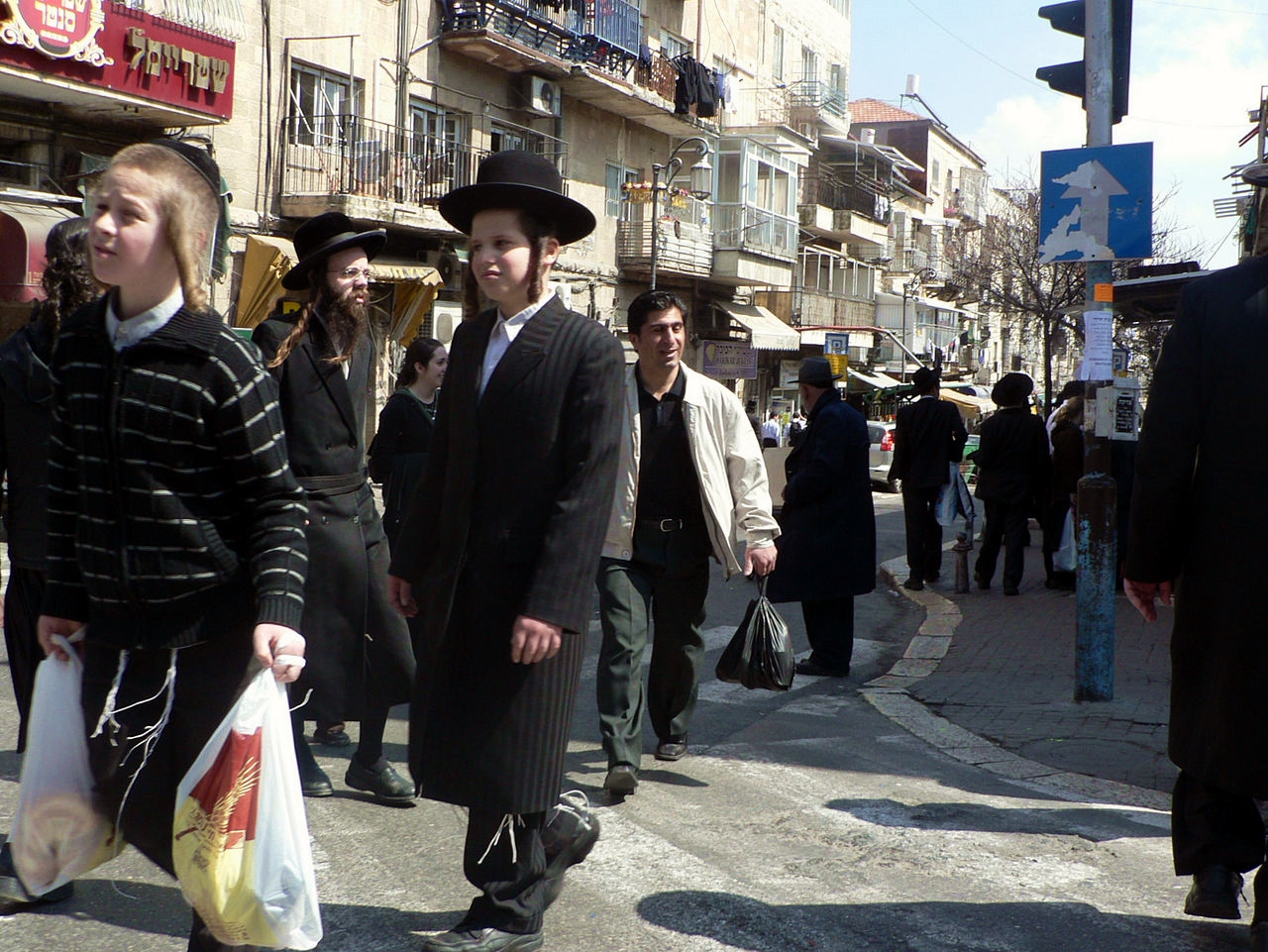
The Mea shearim neighborhood in the heart of Jerusalem.
The Mea Shearim neighborhood in the heart of Jerusalem.
Though Hebrew is now the native tongue of new generations of Israelis and integrated throughout society here, in the ultra-Orthodox religious neighborhood of Mea Shearim in Jerusalem, some still reject Hebrew and use Yiddish for their everyday spoken language. 
Even so, when they pay bills, deal with Israeli companies on the phone, and interact with the larger society, they do have to speak Hebrew.
The Hebrew Bible
While Aramaic was at one time the common language of the Israeli people, including Yeshua (Jesus), it accounts for less than one percent of the Tanakh (Old Testament), which was written primarily in Hebrew.
Out of the over 23,000 verses in the Tanakh, only 250 are written in Aramaic. We find Aramaic, for example, in Ezra 4:8–6:18 and 7:12–26, Daniel 2:4b–7:28, and Jeremiah 10:11.
And although the Brit Chadashah (New Testament) is written primarily in Greek with some Aramaic, it is very Hebraic in nature. 
Why? The writers are Jewish, the culture is Jewish, the religion is Jewish, the traditions are Jewish, and the concepts are Jewish!
The apostle Paul who wrote thirteen of the twenty-seven books of the Brit Chadashah even identified himself as being “circumcised on the eighth day, of the people of Israel, of the tribe of Benjamin, a Hebrew of Hebrews; as to the law, a Pharisee.”  (Philippians 3:5)
A Jewish man reads the TorahBecause of the strong Jewish identity of its writers, we find throughout the Brit Chadashah numerous references to the prophecies and practices of the Hebrew Scriptures.
For that reason alone, learning Hebrew helps us to better understand the true plans and purposes of God.
A Jewish man reads the TorahRoy Blizzard, Jr. in Understanding the Difficult Words of Jesus said,
“If any additional advances are to be made, especially in better-understanding the words of Jesus, the concentration must shift to the study of Hebrew history and culture, and above all, the Hebrew language.”
Believers who learn Hebrew today are doing far more than simply learning another language; they are participating in a great end-time move of the Spirit of God, reconnecting the Church to its Jewish roots, and revealing the true identity of HaMashiach (the Messiah)—Yeshua.
“For out of Zion shall go forth the Torah and the Word of LORD (YHVH)
from Jerusalem.”
 
- Isaiah 2:3

First and foremost, our mission is ministering to Jewish people with love and comfort.
“Comfort, comfort my people (Israel), says your God.” Isaiah 40
Located in the Holy Land, the Bibles For Israel ministry is producing the first-ever Messianic Prophecy Bible.  
We educate Jewish people on the prophecies about the Messiah in the Tanakh (Hebrew Scriptures), showing the truths by defining the Messianic and rabbinical points of view.
Not only are we creating the free Messianic Prophecy Bible in print form, we are tirelessly working on the creation of free Bible software for mobile and computer devices. 
This free software will be used by everyone – from seminary students to Sunday school children in African villages,  and those who are scattered around the four corners of the earth.
Our Bible will reach millions of people in hundreds of languages, spanning all 257 countries and territories in the world.
We also minister to the spiritual and financial needs of the elderly, poor, and single parents. 
Jewish-reads-prayer-holy-book-Western-Wailing-Wall

Tuesday, October 15, 2019

THE HOLOCAUST & THE HIDDEN FACE OF GOD - The Hebrew phrase “hester panim,” the hidden or concealed face of God, is a concept in Judaism that is sometimes applied to the Nazi Holocaust. It is one explanation for God’s seeming absence during the horrors. In Deuteronomy 31:17, the Almighty warned that he would hide His face and withdraw his favour from his people if they disobeyed and served other gods. During many dark periods during the Diaspora, the Jewish people have had to perceive God’s hand of preservation in the shadows. Indeed, miracles of preservations are happening all the time, but they are not as obvious as the parting of the Red Sea. But increasingly, for those who have eyes to see, God is shining out from behind the clouds.


Image result for images anne frank
........................................................................................................................................................
The Holocaust & the Hidden Face of God
By Christine Darg, Jerusalem Channel


“Truly, You are a God who hides Himself, O God of Israel, Savior!” (Isaiah 45: 15)


As we meditate on Holocaust Memorial Day, the Hebrew phrase “hester panim,” the hidden or concealed face of God, is a concept in Judaism that is sometimes applied to the Nazi Holocaust.
It is one explanation for God’s seeming absence during the horrors.
The concept of hester panim is also alluded to in Purim commentaries since the Book of Esther does not overtly mention the name of God (although his name is encoded as an acrostic).
The hidden or concealed face of God is one reason why during Purim masks and costumes are worn.
In the Torah in Deuteronomy 31:17, the Almighty warned that he would hide His face and withdraw his favour from his people if they disobeyed and served other gods:
“And in that day I will become angry with them and forsake them; I will hide my face from them, and they will be destroyed. Many disasters and calamities will come on them, and in that day they will ask, ‘Have not these disasters come on us because our God is not with us?’”
Consequently, according to the great commentator Rashi, it would appear “as if” God didn’t see the distress of his people.
In Deuteronomy 31:18, in the original Hebrew, there is an idiomatic expression, a play on words that does not translate into English but amounts to a double hiding.
The conclusion, interestingly, is that the Jewish sage of the Middle Ages, Aben Ezra, as well as the Ramban and other revered rabbis have explained that there would be two hidings of God’s face in Jewish history.
The first hiding was after the destruction of the First Temple during the Jews’ exile to Babylon; that hester panim lasted only a relatively short time — 70 years —  about a generation.
But the second hiding has been extensive — the current Diaspora in the nations, which started with the destruction of the Second Temple in 70 AD, and is coming to a conclusion beginning with the rebirth of the modern state of Israel.
During many dark periods during the Diaspora, the Jewish people have had to perceive God’s hand of preservation in the shadows.
Indeed, miracles of preservations are happening all the time, but they are not as obvious as the parting of the Red Sea.
But increasingly, for those who have eyes to see, God is shining out from behind the clouds.
Recall during the Gulf War how Iraq rained down 39 Scud missiles on Israel, and Israel’s divine preservation was a public miracle!
As an evangelical believer, I find it infinitely fascinating that the Talmud comments on Jerusalem’s widowhood after the destruction of the Temple as a temporary situation. 
Jerusalem is likened to a woman whose husband has gone overseas but who has every intention of returning! 
The same analogy is made in the Midrash in Kohellet Raba — a parable about a woman who makes herself beautiful in the absence of her husband, because she must be ready for his imminent return.
Revelation 19:7 speaks of the Bride of the Messiah, who anticipates his imminent return: “Let us rejoice and be glad and give him glory! For the wedding of the Lamb has come, and his bride has made herself ready.”
According to the Jewish Tanach, the Hebrew Scriptures, God himself has described his hester panim in Hosea 5: 14-15
“For I will be unto Ephraim as a lion,
And as a young lion to the house of Judah;
I, even I, will tear and go away,
I will take away, and there shall be none to deliver.
I will go and return to My place,
Till they acknowledge their guilt, and seek My face;
In their trouble they will seek Me earnestly.”
The Bible makes it clear that the time of hester panim will end after the Holocaust, according to Ezekiel 37:
“Then he said to me: ‘Son of man, these bones are the people of Israel. They say, “Our bones are dried up and our hope is gone; we are cut off.” 
“12Therefore prophesy and say to them: ‘This is what the Sovereign Lord says: My people, I am going to open your graves and bring you up from them; I will bring you back to the land of Israel.’
“13Then you, my people, will know that I am the Lord, when I open your graves and bring you up from them. 
“14I will put my Spirit in you and you will live, and I will settle you in your own land. Then you will know that I the Lord have spoken, and I have done it, declares the Lord.’ ”
Thankfully, living on Israel’s resurrection side of the Holocaust, we know that the second period of hester panim is drawing to a close. God is coming out of hiding.
Jerusalem will experience the outpouring of the spirit of grace and supplications. (Zechariah 12:10)
All Israel shall be saved. (Romans 11: 26) It is the most exciting prophetic time to be alive!
“’In an outburst of anger I hid My face from you for a moment, But with everlasting lovingkindness I will have compassion on you,’ Says the LORD your Redeemer.” ~ Isaiah 54: 8
“’I will not hide My face from them any longer, for I will have poured out My Spirit on the house of Israel,’ declares the Lord GOD.” ~ Ezekiel 39: 29
“In all their affliction He was afflicted, and the Angel of His presence saved them: in His love and in His pity He redeemed them; and He bare them, and carried then all the days of old.” ~ Isaiah 63: 9

The Jerusalem Channel is a media ministry with the vision to share the Gospel from Jerusalem to the ends of the earth. Through videos, news and insight, the Jerusalem Channel brings you the latest information on events in the Holy Land and global news with a Judeo-Christian perspective.

Friday, September 28, 2018

DIASPORA - The word Diaspora means “to sow throughout” or “to distribute in foreign lands” or “scatter abroad.” God had allowed - even orchestrated - the spreading of millions of Jews throughout the Roman Empire to serve as a key part in the rapid spread of the gospel. Originally, it referred to all Jews who lived outside of Israel. Then it took on a more limited meaning, referring specifically to Jewish Christians who were scattered throughout the Roman Empire. Finally, we see an even more general meaning as it applies to both Jewish and Gentile Christians who were scattered around an often hostile world.

Image result for images the wandering jews fiddler on the roof
.....
.Diaspora
Image result for images the wandering jews fiddler on the roof
What does the Bible mean when it refers to the Diaspora?
.
The word Diaspora is a transliteration of a Greek word that means “to sow throughout” or “to distribute in foreign lands” or “scatter abroad.”
Some form of the Greek word is seen in six different New Testament passages, and at its simplest meaning, the Diaspora refers to Jews who were living outside of Israel having been dispersed or scattered to other Gentile countries.
In modern parlance, the Diaspora refers to the scattering of the Jews throughout Europe who returned to their homeland in 1948 with the creation of the state of Israel by a United Nations resolution.
Throughout the history of Israel, the Jewish people were conquered and sent into exile several different times.
While many of them had returned to Israel when the opportunity arose, many others stayed in the Gentile countries.
But the forced exile of Jews was only a small part of the reason that Jews would have been scattered throughout much of the Roman Empire during the New Testament time.
Other economic and political influences led to many other Jews leaving Israel for more comfortable and profitable lands.
There were large Jewish populations in both Egypt and Syria, with an estimated Jewish population in Alexandria, Egypt, alone, of more than one million Jews.
During Roman rule many Jews were also taken to Rome as slaves, and there were large Jewish populations in several different parts of the Roman Empire.
The Roman historian Mommsen wrote, “The inhabitants of Palestine were only a portion, and not the most important portion, of the Jews; the Jewish communities of Babylonia, Syria, Asia Minor and Egypt were far superior to those of Palestine.”
Jews were scattered across so much of the known world that the Jewish historian Josephus wrote that “there is no city, no tribe, whether Greek or barbarian, in which Jewish law and Jewish customs have not taken root.” 
Clearly, by the time of Christ’s coming, Jews were scattered throughout the Roman Empire.
So at the time Jesus began His earthly ministry, there were likely more Jews living outside of Israel than in it.
This is important to realize because it helps us to understand just how perfect the timing of Jesus’ coming was.
With Greek being widely spoken throughout the Roman Empire and Jews having been scattered or dispersed among the nations, the time was right for Jesus to come and the gospel to spread throughout the Roman Empire.
As Galatians 4:4-5 says, “But when the fullness of the time had come, God sent forth His Son, born of a woman, born under the law, to redeem those who were under the law, that we might receive the adoption as sons” (emphasis added).
So, in the broadest meaning of the word, the Diaspora would refer to the countless Jews living outside of Israel, and that is exactly the meaning we see in John 7:35 where the Jewish religious leaders would wonder where Jesus was going and if He was intending to go to “the Dispersion among the Greeks and teach the Greeks.”
Jesus had told them that where He was going they could not come, nor could they find Him.
Jesus, of course, was speaking of returning to be with God the Father, but the Jewish leaders thought He was going to be with Jews scattered abroad instead.
However, in the rest of the New Testament, the meaning of the Diaspora seems to evolve somewhat.
First it refers more specifically to Jewish Christians who were spread out all over the Roman Empire rather than Jews in general.
In Acts 8:1-4 we see the gospel being spread as the persecution of Jewish Christians began in Jerusalem, so the Jewish Christians were “scattered” or dispersed “throughout the regions of Judea and Samaria” and “those that were scattered went everywhere preaching the word.”
Those first Jewish Christians who fled Israel because of the persecution that started after the death of Stephen would have gone throughout the Roman Empire taking the message of Jesus Christ to already established and sizable Jewish communities and synagogues all over the Roman Empire.
Again, in Acts 11:19, we see the word used referring to Jewish Christians, who “scattered after the persecution that arose over Stephen [and] traveled as far as Phoenicia, Cyprus, and Antioch, preaching the word to no one but the Jews only.”
God had allowed - even orchestrated - the spreading of millions of Jews throughout the Roman Empire to serve as a key part in the rapid spread of the gospel.
As Jewish Christians were forced to flee Jerusalem due to persecution, they were able to travel to almost any part of the world and find a Jewish population and a Jewish synagogue from which to share the gospel of Christ.
Because the Jews already knew the Old Testament, the background was set and the timing was perfect for the gospel to spread throughout the nations.
So, when James wrote in his Epistle that he was writing to “the twelve tribes which are scattered abroad” (James 1:1), he was clearly writing to Jewish Christians whom God had scattered throughout the Roman Empire.
But then Peter’s use of the term takes on an even fuller meaning and now involves both Jewish and Gentile Christians who were scattered throughout the provinces in Asia Minor: “To the pilgrims of the Dispersion in Pontus, Galatia, Cappadocia, Asia and Bithynia” (1 Peter 1:1).
We know from the context of 1 Peter that he is writing to both Jewish and Gentile Christians, so we see the word Diaspora now referring to Christians in general, both Jew and Gentile.
In looking at the different passages where this word is found, we can see how the meaning of Diaspora has somewhat evolved in the New Testament.
Originally, it referred to all Jews who lived outside of Israel. Then it took on a more limited meaning, referring specifically to Jewish Christians who were scattered throughout the Roman Empire.
Finally, we see an even more general meaning as it applies to both Jewish and Gentile Christians who were scattered around an often hostile world.
Image result for images jewish bottle dance

Image result for images the wandering jews fiddler on the roofImage result for images the wandering jews fiddler on the roofImage result for images the wandering jews fiddler on the roof

Image result for images jewish bottle danceImage result for images diaspora scattering of the jewsImage result for images the wandering jews fiddler on the roof

Image result for images diaspora scattering of the jewsImage result for images diaspora scattering of the jewsImage result for images diaspora scattering of the jews

Image result for images diaspora scattering of the jewsImage result for images diaspora scattering of the jewsImage result for images diaspora scattering of the jews

Image result for images diaspora scattering of the jewsImage result for images diaspora scattering of the jewsImage result for images the wandering jews

Image result for images the wandering jewsImage result for images the wandering jewsImage result for images the wandering jews

Image result for images the wandering jews fiddler on the roofImage result for images the wandering jews fiddler on the roofImage result for images the wandering jews fiddler on the roof