Showing posts with label Israel. Show all posts

Wednesday, August 26, 2020

ISAIAH 35:1 PROPHECY COMING TO PASS — ARE WE ON THE BRINK OF JESUS' RETURN? - When Jesus returns in glory, the deserts will begin to bloom. Interestingly enough, this prophecy is beginning to happen in our time. Over the years, Israel has developed remarkable irrigation techniques. The Arava produces over one-half of Israel's agricultural exports, which includes crops such as squash, dates and strawberries. They are also growing flowers! As we look at the amazing progress of God's people in the desert, we are reminded of God's promise in Isaiah 35. It is a promise that will be brought to fulfillment at the return of Jesus to rule and reign. This is a tremendous sign of the end. The Spirit and the Bride say come! "The wilderness and the solitary place shall be glad, and the desert shall rejoice and blossom as the rose" Isaiah 35 describes the return of Jesus. When He returns in glory, the deserts will begin to bloom. Interestingly enough, this prophecy is beginning to happen in our time. The Hebrew word translated as desert in Isaiah 35:1 is arabah or aravah. While it is a generic word that can refer to a desert place, it is also a specific word referring to a desert valley in Israel. When Israel first gained independence in 1948, the Arava was a barren place. Over the years, Israel has developed remarkable irrigation techniques. These practices have turned the former desert valley into a prosperous source of agricultural production.

When He returns in glory, the deserts will begin to bloom.
..................................................................................................................................................................
Coming Soon: The Magnificent Millennium | United Church of God
Isaiah 35:1 Prophecy Coming to Pass — Are We on the Brink of Jesus' Return?
.
Beyond the Sunday School - A Bible Blog by Jacob Cherian: Isaiah 35When Jesus returns in glory, the deserts will begin to bloom. Interestingly enough, this prophecy is beginning to happen in our time. Over the years, Israel has developed remarkable irrigation techniques. The Arava produces over one-half of Israel's agricultural exports, which includes crops such as squash, dates and strawberries. They are also growing flowers! As we look at the amazing progress of God's people in the desert, we are reminded of God's promise in Isaiah 35. It is a promise that will be brought to fulfillment at the return of Jesus to rule and reign. This is a tremendous sign of the end. The Spirit and the Bride say come!
KELLY MCDONALD JR.


"The wilderness and the solitary place shall be glad, and the desert shall rejoice and blossom as the rose" - (Isaiah 35:1).


St. Walburga's Blog: December 2013Isaiah 35 is a chapter that describes the public return of Jesus.
When He returns in glory, the deserts will begin to bloom.
Interestingly enough, this prophecy is beginning to happen in our time.
The Hebrew word translated as desert in Isaiah 35:1 is arabah or aravah.
While it is a generic word that can refer to a desert place, it is also a specific word referring to a desert valley in Israel.
When Israel first gained independence in 1948, the Arava was a barren place.
Matthew 11:2-11 Commentary by Arland J. Hultgren - Working Preacher -  Preaching This Week (RCL)Very few people wanted to live there. As of 2017, 14,000 people live in this area, which is approximately 108 miles long.
Over the years, Israel has developed remarkable irrigation techniques.
These practices have turned the former desert valley into a prosperous source of agricultural production.
A recent report stated that the Arava produces over one-half of Israel's agricultural exports, which includes crops such as squash, dates and strawberries.
They are also growing flowers!
Flowers Foreshadow the Messiah's Return!When we study prophecy, there are events that occur leading up to the fulfillment of God's prophetic word.
God prophesied the destruction of Jerusalem and a time of captivity for the nation of Judah (2 Kings 21:7-15).
Nebuchadnezzar took at least one group of people to Babylon before the final destruction and captivity in 586 BC (see 2 Kings 24:1-12, 2 Kings 25).
As we look at the amazing progress of God's people in the desert, we are reminded of God's promise in Isaiah 35.
476 Best Isaiah images in 2020 | Isaiah, Major prophets, Suffering servantIt is a promise that will be brought to fulfillment at the return of Jesus to rule and reign.
This is a tremendous sign of the end. The Spirit and the Bride say come!

Kelly McDonald Jr. is an ordained evangelist at Hungry Hearts Ministries in Jackson, Tennessee. He has written over 40 books and booklets on pursing Christ, Hebrew roots and end-times prophecy. He is currently president of the Bible Sabbath Association (BSA). You can follow him at kellymcdonaldjr.com.

Saturday, June 13, 2020

THE GOLAN HEIGHTS: 5 FACTS - When Jewish tribes first settled in the land of Israel, the tribes of Gad and Reuben asked Moses for permission to settle east of the Jordan River. Moses agreed and also sent half of the tribe of Manasseh who settled in “Golan in the (region called) the Bashan” in the modern-day Golan Heights. The Golan Heights are so often in the news that one might be forgiven for thinking the area is a large one, full of people. In fact, the area of the Golan Heights that’s held by Israel is only about 1,200 square km. About 40,000 people live in the Golan; most of these residents are members of the Druze and Alawite minorities who inhabit several villages and small towns in the hills. In addition, there are 32 Jewish towns and Jewish farming communities across the Golan. Mount Hermon in the north of the Golan is about 2,800 meters, and is a popular skiing destination. A few miles south, the hills along the Yarmuk River, which flows through the southern part of the Golan, are about 400 meters, or 1,300 feet tall. It’s a beautiful region, and several Israeli national parks and protected areas now dot the area. Between 1948, when the state of Israel was established, and 1967, when Israel captured the Golan Heights from Syria, Syrian artillery batteries regularly shelled the entire region of northern Israel. They also allowed Fatah, the PLO’s political arm, to carry out attacks from the region.

The Golan Heights: 5 Facts
................................................................................................................................................
The Golan Heights: 5 Facts
by Dr. Yvette Alt Miller

A short guide to the history and strategic value of the Golan Heights.


The Golan Heights are Israel’s buffer against its northern neighbor Syria.
In Israeli hands since 1967, the Golan Heights are back in the news today, after President Trump signed a proclamation recognizing Israel’s sovereignty.
Here are five facts about the Golan Heights to provide some background at this historic moment.
Historical Ties
The Golan is the site of some of the Torah’s most vivid histories.
When Jewish tribes first settled in the land of Israel, the tribes of Gad and Reuben asked Moses for permission to settle east of the Jordan River.
Moses agreed and also sent half of the tribe of Manasseh who settled in “Golan in the (region called) the Bashan” in the modern-day Golan Heights (Deuteronomy 4:43).
Jews built a busy and pious community there, but the area was under constant attack from the Aramean kingdom to the region’s north.
The Book of Kings describes the monumental battle in the 9th Century BCE when the combined forces of the Jewish tribes of Judah and Israel defeated the Aramean armies in the Golan: “It happened...that (King) Ben-Hadad counted Aram, and he went up to Aphek to wage war against Israel… the battle was joined, and the Children of Israel struck down Aram – a hundred thousand foot soldiers in one day” (I Kings 20:26-29).
Remains of a Byzantine bathhouse, in Kursi National Park,
Golan Heights
Jewish communities in the Golan flourished. Many of the battles against the Syrian Greek army that we celebrate during the holiday of Hanukkah took place in the area.
Judah Maccabee led Jewish troops against the Greeks in the area, and his grand-nephew, the Jewish King Alexander Jannai, who ruled from 103-76 BCE, annexed the Golan region, adding it to his territory.
When the Roman Empire crushed the Jewish kingdom of Judah, the Golan was one of the very last areas to fall, only defeated in the year 67 CE.
While Jewish autonomy ended, Jewish life in the Golan continued to flourish.
Archeologists have uncovered the remains of 34 ancient synagogues in the area, dating from the end of the Judean kingdom in 70 CE.
Throughout the Roman period, Jewish life in the Golan flourished, with synagogues and centers of learning sustaining a literate, pious Jewish community.
That came to end in the 7th Century when Islamic tribes crushed the Jewish communities in the territory.
The last battle against the Islamic conquest, fought in the Yarmouk Valley in the year 636, took place in the Golan Heights.
After that, Jews were driven out of the area for centuries.
Zionist Farmers in the Golan
Jewish life briefly returned to the Golan in 1891 when Jewish pioneers began to purchase and farm land in the region.
Baron Edmond de Rothschild bought 18,000 acres in the area of Ramat Magshimim, in the Golan.
Jews built five small farms in the Golan area’s verdant hills.
The Jewish pioneers’ farming experiment came to an end in 1898 when local Turkish authorities evicted the Jews and seized their land.
At the end of World War I, Britain took control of the area; in 1923 they gave the Golan to France, along with the territories of present-day Syria and Lebanon.
In 1947, Syria forced Jews out of the Golan Heights, and used the area to shell Israeli towns and farms that were in the sights of the towering hills of the Golan instead.
Small Area
The Golan Heights are so often in the news that one might be forgiven for thinking the area is a large one, full of people.
In fact, the area of the Golan Heights that’s held by Israel is only about 1,200 square km., or about 500 square miles.
About 40,000 people live in the Golan; most of these residents are members of the Druze and Alawite minorities who inhabit several villages and small towns in the hills.
In addition, there are 32 Jewish towns and Jewish farming communities across the Golan.
Mount Hermon in the north of the Golan is about 2,800 meters, or 9,300 feet tall, and is a popular skiing destination.
A few miles south, the hills along the Yarmuk River, which flows through the southern part of the Golan, are about 400 meters, or 1,300 feet tall.
It’s a beautiful region, and several Israeli national parks and protected areas now dot the area.
Between 1948, when the state of Israel was established, and 1967, when Israel captured the Golan Heights from Syria, Syrian artillery batteries regularly shelled the entire region of northern Israel.
They also allowed Fatah, the PLO’s political arm, to carry out attacks from the region.
Haifa is only about 60 miles from the Golan Heights, and the Golan affords an excellent view of the Hula Valley in Israel’s north, which is Israel’s most fertile agricultural region.
For years, Israeli children were forced to sleep in bomb shelters.
Many roads in Israel’s north could only be driven along after mine-detection trucks cleared the streets.
Former Israeli Prime Minister Golda Meir recalled the misery that Syrians created for Israelis in the crosshairs of the Golan Heights.
“The Syrians seemed bent on an escalation of the conflict; they kept up an endless bombardment of the Israeli settlements below the Golan Heights, and Israeli fishermen and farmers faced what was sometimes virtually daily attacks by snipers. I used to visit those settlements occasionally and watch the settlers go about their work as though there was nothing at all unusual in ploughing with a military escort or putting children to sleep – every single night – in underground air-raid shelters” (quoted in My Life by Golda Meir).
Recognizing that Syria was using the Golan Heights to attack Israel, the UN sent troops to police the border between Israel and Syria.
In 1966, Israel appealed to this body, the UN Mixed Armistice Commission, asking them to stop Syria from allowing PLO troops to bomb Israel from the Golan.
The UN refused to condemn Syria, though it did condemn Israel when Israeli troops dared fire upon Syrian positions in the Golan.
The Six Day War
After years of provocation, Israel gained the Golan Heights during the Six Day War of 1967.
Fighting started on June 5, 1967, when Israel launched a preemptive strike on Egypt.
Syria used the Golan Heights to shell villages and farms in the Hula Valley, and also sent planes to bomb Haifa.
On June 9, Israel engaged Syrian fighters in the Golan and captured the area with seemingly miraculous speed, by the afternoon of June 10.
Archeologists soon found reminders of the area’s historic ties to Israel: coins dating from the 2nd Century CE inscribed with the words “For the Redemption of Jerusalem”.
Syria tried to regain the Golan six years later, in 1973, when they, along with Egypt, and supported by nine other Arab nations, staged a surprise attack on Israel on Yom Kippur.
They were unsuccessful and Syria later signed a disengagement agreement as part of their armistice with Israel that left the Golan in Israel’s hands.
UN troops were stationed at the border of the now Israeli-controlled Golan Heights and Syria, though Israel never used the Golan Heights to shell Syrian territory the way Syria used the commanding hills to terrorize Israel.
In 1981, Israel effectively annexed the Golan Heights, reflecting the key security importance of the area.
Syrian continues to demand its return.
In 1999, during peace talks with Yasser Arafat that many Israelis thought might lead to a permanent peace with the PLO, Syria disclosed its position: they would only agree to peace with Israel if Israel returned the entire Golan Heights.
They wanted to be able to reestablish military positions on the hills, and also control the freshwater sources of the area.
Given their experience with Syrian aggression in the area, Israelis refused to even consider this outrageous demand.
Humanitarian Aid in the Golan
With the humanitarian disaster of Syria’s brutal civil war now in its eighth year, Israelis have used the Golan region to provide life-saving humanitarian aid to Syrian refugees.
In June 2016, the Israel Defense Force (IDF) launched Operation Good Neighbors, which coordinates massive amount of medical and material aid in the Golan area.
Under Operation Good Neighbors, Israel has distributed over 1,500 tons of food, over 250 tons of clothes, about a million liters of fuel, dozens of generators, and about 25,000 containers of medical equipment and medicine.
In one week in 2018 alone, the IDF’s Bashan Brigade carried out six risky operations in the Golan Heights, delivering hundreds of tons of aid, including clothing and children’s toys, to civilians in Syria.
When fighting from Syria’s civil war neared the Golan in July 2018, the Israeli Golan Regional Council launched a major drive to collect items to distribute to Syrian refugees in a buffer zone just outside Israeli control.
“We would love any families in the Golan to make sealed bags for a Syrian child with toys and... coloring pages, crayons and sweets... to provide them with a moment of sweet and sweet joy” the council asked.
“These are our neighbors and we see this as a mitzvah to help them in times of trouble” explained Council head Eli Malka.
Within hours, thousands of donations had poured in.
The brutal fighting continues to rage near to the Golan Heights, a constant reminder of how crucial it is that Israel control the historic and strategically critical area of the Golan.
Dr. Yvette Alt Miller. Yvette Alt Miller earned her B.A. at Harvard University. She completed a Postgraduate Diploma in Jewish Studies at Oxford University, and has a Ph.D. In International Relations from the London School of Economics. She lives with her family in Chicago, and has lectured internationally on Jewish topics. Her book Angels at the table: a Practical Guide to Celebrating Shabbat takes readers through the rituals of Shabbat and more, explaining the full beautiful spectrum of Jewish traditions with warmth and humor. It has been praised as "life-changing", a modern classic, and used in classes and discussion groups around the world.https://www.aish.com/jl/li/ji/The-Golan-Heights-5-Facts.html?s=ras
The Golan Heights: 5 Facts

Tuesday, May 19, 2020

THE HEBRON PURCHASE - The first part of the land of Israel to belong to the Jewish people in the actual and legal sense was the “Machpelah field and its cave” in the heart of Hebron, which Abraham purchased from Ephron the Hittite. In Genesis 23, we read of the first tract in the Land of Israel to enter into Jewish possession. Sixty years earlier, G‑d had told Abraham: “The entire land that you see, I will give to you and your descendants forever . . . Arise and traverse the land, in its length and in its breadth, for to you I shall give it” But this was a promise concerning the future; the land was not yet his, and Abraham took care not to even allow his sheep to graze on Canaanite property. The first part of the land of Israel to belong to the Jewish people in the actual and legal sense was the “Machpelah field and its cave” in the heart of Hebron, which Abraham purchased from Ephron the Hittite. As our sages point out, there are three parts of Israel over which the Jewish right of ownership is most powerfully established. Even one who denies the divine promise quoted above — and reiterated by G‑d tens of times throughout the Bible — cannot contest the Jewish right over the Temple Mount in Jerusalem, purchased by King David from Aravnah the Jebusite; the section of Shechem (Nablus) purchased by Jacob from the family of the Canaanite ruler Hamor; and the Machpelah field of Hebron, of which we read: “And Abraham weighed to Ephron the silver, which he had named in the hearing of the sons of Heth, four hundred shekels of silver in negotiable currency . . . “Then Abraham buried Sarah his wife in the cave of the field of Machpelah before Mamre, that is Hebron, in the land of Canaan.”

Hebron – Travel guide at Wikivoyage
..............................................................................................................................................................
The Hebron Purchase
.
A Brief Overview of Hebron | The Hebron FundThe first part of the land of Israel to belong to the Jewish people in the actual and legal sense was the “Machpelah field and its cave” in the heart of Hebron, which Abraham purchased from Ephron the Hittite
By Yanki Tauber


In chapter 23 of Genesis, we read of the first tract in the Land of Israel to enter into Jewish possession.
Sixty years earlier, G‑d had told Abraham: “The entire land that you see, I will give to you and your descendants forever . . . Arise and traverse the land, in its length and in its breadth, for to you I shall give it” (Genesis 13:15,17).
But this was a promise concerning the future; the land was not yet his, and Abraham took care not to even allow his sheep to graze on Canaanite property.
(Indeed, this was the cause of the split between Abraham and his nephew Lot — see Rashi on Genesis 13:7.)
The first part of the land of Israel to belong to the Jewish people in the actual and legal sense was the “Machpelah field and its cave” in the heart of Hebron, which Abraham purchased from Ephron the Hittite.
Hebron The Promise | Jewish art, Judaica art, ArtAs our sages point out, there are three parts of Israel over which the Jewish right of ownership is most powerfully established.
Even one who denies the divine promise quoted above — and reiterated by G‑d tens of times throughout the Bible — cannot contest the Jewish right over the Temple Mount in Jerusalem, purchased by King David from Aravnah the Jebusite (as related in the closing verses of II Samuel); the section of Shechem (Nablus) purchased by Jacob from the family of the Canaanite ruler Hamor (Genesis 33:19); and the Machpelah field of Hebron, of which we read:
“And Abraham weighed to Ephron the silver, which he had named in the hearing of the sons of Heth, four hundred shekels of silver in negotiable currency . . .
“Then Abraham buried Sarah his wife in the cave of the field of Machpelah before Mamre, that is Hebron, in the land of Canaan.”
Abraham's Purchase of Maarat Hamachpela | The Hebron FundThe Torah recounts the Ephron-Abraham sale in great detail, including the sum of the purchase price — four hundred silver shekels.
Based on this figure, the thirteenth-century sage Rabbi Yitzchak bar Yehudah (author of Paaneach Raza) makes an interesting calculation.
According to Leviticus 27:16, the value of land in biblical times was 50 silver shekels for a beit kor, or 75,000 square amot (cubits).
Thus, the area purchased by Abraham was eight beit kor, or 600,000 square cubits.
A square cubit is the approximate area occupied by an upright human being. 
The generation of Jews which left Egypt and received the Torah at Mount Sinai numbered some 600,000 heads of households.
Honoring the life of Sarah: 50,000 Jews gather in Hebron for ...Our sages tell us that the Jewish nation consists of 600,000 souls, and that the soul of every Jew who ever lived is an offshoot of one of these 600,000 “general” souls.
Thus, the Torah contains 600,000 letters (counting the spaces between letters), for each Jew possesses something of the Torah.
The same is true of the Land of Israel. Israel is the eternal inheritance of the Jewish people, equally the property of every individual Jew.
And so, it has been from the very first moment of Jewish ownership of the Holy Land: the first plot of land obtained by the first Jew included a share for every Jewish soul. 

By Yanki Tauber; based on the teachings of the Rebbe.

Yanki Tauber served as editor of Chabad.org
Full Text: Abraham Buys Cave of Machpela - Genesis 23 | the Jewish ...

Wednesday, October 2, 2019

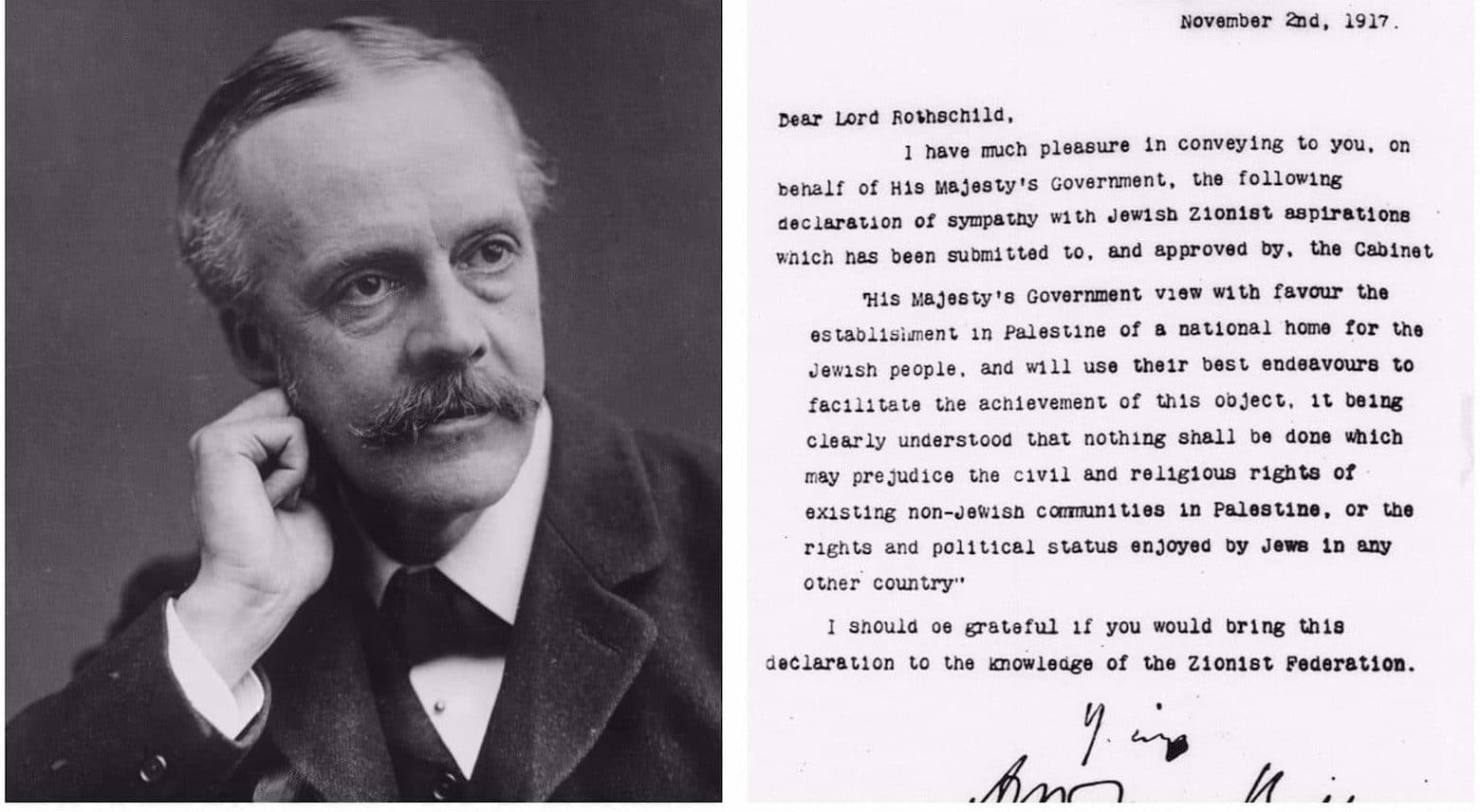
THE BALFOUR DECLARATION - The people, the Book and the Land are thoroughly intertwined, and the long exile away from Israel has been a matter of grief expressed in Jewish liturgy throughout the generations. Whenever a Jewish couple marry, whenever a Jewish person dies, whenever traditional Jewish blessings are made over meals, the prayers include a longing for Israel and Jerusalem. So just imagine the joy that many felt when the Balfour declaration was made public by the British government in 1917 to establish a Jewish homeland in Palestine. Britain’s refusal to give the Jewish people a national home, or even a haven, was ruled illegal. Sadly, it was too late for millions of Jewish people who perished at the hands of the Nazis. At a time when they most needed a refuge, Britain was turning Jewish people away and denying them access to the land of their forefathers.


...................................................................................................................................................................
The Balfour Declaration
Things People Forget About The Balfour Declaration 100 Years On
By ONE FOR ISRAEL (Messianic Jews In Israel)


What are we to make of the Balfour Declaration today?
These words have been prayed by Jewish people around the globe quite literally every morning, noon and night, throughout their 2000 year exile:
“Sound the great shofar for our freedom; raise the banner to gather our exiles, and gather us from the four corners of the earth. Blessed art thou, O Lord, who gathers the dispersed of Your people Israel.” 
“Return in compassion to your city, Jerusalem, and rest within it as You have said; rebuild it soon in our days as an everlasting building, and speedily set up therein the throne of David. Blessed art thou, O Lord, who rebuilds Jerusalem.”
Wherever they may be in the world, Jewish people traditionally say these blessings as part of their prayers three times a day, facing Jerusalem. Just like Daniel.
The people, the Book and the Land are thoroughly intertwined, and the long exile away from Israel has been a matter of grief expressed in Jewish liturgy throughout the generations. 
Whenever a Jewish couple marry, whenever a Jewish person dies, whenever traditional Jewish blessings are made over meals, the prayers include a longing for Israel and Jerusalem. 
So just imagine the joy that many felt when the Balfour declaration was made public by the British government in 1917 to establish a Jewish homeland in Palestine:
“His Majesty’s Government view with favour the establishment in Palestine of a national home for the Jewish people, and will use their best endeavours to facilitate the achievement of this object, it being clearly understood that nothing shall be done which may prejudice the civil and religious rights of existing non-Jewish communities in Palestine, or the rights and political status enjoyed by Jews in any other country.”
Arthur James Balfour, British foreign secretary, 2 November 1917
(To read the full letter, see transcript below)
Now it must be said that although it was the answer to literally billions of prayers (just think of it – three times every day by millions of Jews – for two millennia!) not to mention the fulfillment of prophecies uttered by almost every Biblical prophet, this declaration has caused more than a little consternation.
Palestinian leaders are demanding an apology from the British government for giving away what was not theirs to give.
After the passing of a hundred years, most have forgotten that it was not a unilateral act of the UK.
There was no UN at that time, or even League of Nations, but in the wake of the Turks finally losing their grip on the countries in the Levant, several nations were allied in agreement that there should be some provision made for the Jewish people within Palestine. 
1) Britain did not act alone, but it was a move endorsed by many nations together.
The aspiration to create a homeland for the Jewish people had the agreement of President Woodrow Wilson since the US had joined the first World War, as well as Italy and Japan who, along with Britain and France, would participate in the San Remo conference and become members of the Council of the League of Nations.
Even the Pope had assented, describing return of the Jews to Palestine as “providential; God has willed it.”
The Cambon letter Issued in June 1917 clarified full support for the cause from the French government:
“It would be a deed of justice and of reparation to assist, by the protection of the Allied Powers, in the renaissance of the Jewish nationality [nationalité juive] in that land from which the people of Israel were exiled so many centuries ago”.
And so the foreign ministers of Britain (Balfour), France (Pichon), the United States (Robert Lansing), Italy (Sidney Sonnino), and Japan (Makino Nabuaki) all had been in agreement with the endeavour.
“In the era before the United Nations and the League of Nations, there existed no higher international forum than this”, according to Middle East historian, Martin Kramer. [1]
The British government have declined to issue an apology to the Palestinian leadership, saying,
“The Balfour Declaration is an historic statement for which HMG (Her Majesty’s Government) does not intend to apologize. We are proud of our role in creating the State of Israel. The task now is to encourage moves towards peace… The Declaration was written in a world of competing imperial powers, in the midst of the First World War and in the twilight of the Ottoman Empire. In that context, establishing a homeland for the Jewish people in the land to which they had such strong historical and religious ties was the right and moral thing to do, particularly against the background of centuries of persecution.” [2]
As the British response states, the British Empire was not the only empire at large at the time.
Certainly, there are matters in the histories of each of our nations that should cause mortification when we consider the evil that has been done in the past.
However, Ottoman Turks were from Turkey, not Palestine. People forget that the Ottoman Empire was a colonialist enterprise too.
2) Palestine was not free, but had been under occupation by the Turkish Empire for 400 years.
It is important to remember that in 1917 the Middle East was not a collection of autonomous nations that were suddenly overrun by the West. 
The Ottoman Empire was just that – an empire. The Turks had been the colonizers for four centuries, and before them, there had been a series of Muslim and Christian empires dominating the region and to some degree imposing their religions, or restricting the religions of others.
There was the Byzantine empire, ruling from Constantinople, followed by an invasion from Arabia which imposed Islam on the region, followed by the Crusaders from Europe, the Mamluks from Egypt, and then the Ottomans from Turkey.
Different Islamic powers had conquered and taken control for 973 years, imposing the “Jizya” tax on non-Muslims and outlawing church bells and construction of synagogues and churches.
Jews and Christians living in Palestine had been second class citizens for 80% of the centuries-long Turkish occupation. 
Equal rights were not given to non-Muslims until 1839, and only in order to appease the Europeans as the Turks struggled to maintain sovereignty in the region. [3] 
Consider: when was the last time that Palestine actually ruled itself? When was it ever free from occupation?
It was free just before the Roman occupation that was in force at the time of Yeshua, after the Israelites had successfully beaten back the Greek occupation in 167 BCE.
The Jews had a sizable chunk of self-rule then, and hundreds of years of autonomy between the Exodus and the first exile to Babylon.
Apart from that, the land has been passed back and forth from pillar to post, from conqueror to conqueror, and the people of the land just had to deal with whatever powers had control at the time.
The allied forces were to some extent attempting to parcel out the lands of the Middle East away from the hands of the Turks and back to the people groups themselves.
There is much to say about their method and the measure of success, but Rabbi Jonathan Sacks, Chief Rabbi of the UK, declared it “visionary and moral politics of a high order”.
Perhaps it is not hard to imagine a higher morality, since the integrity of the allied powers was severely compromised by self-interest, but there is some weight to the idea that the intention was to return the lands rather than to take them. Sacks continues,
“It was an anti-imperialist gesture, after centuries of Christian and Muslim imperialism with no autonomous states, they attempted to return Ottoman ruled lands to the tribes that lived in them. Lloyd George was seeking more justice and wanting an end of the days of Empire, to return the lands to their original inhabitants.” [4]
The San Remo conference in April 1920 turned former Ottoman territories into mandates, which would be administered on behalf of the League of Nations. 
They made Britain “responsible for putting into effect the declaration originally made on November 2, 1917, by the Government of His Britannic Majesty, and adopted by the said Powers.”
3) Britain soon changed its tune, blocking Jewish immigration just as the Holocaust hit its peak.
Due to national self-interest, Britain issued the infamous White Paper of 1939, severely limiting Jewish immigration to Palestine during World War II, and currying favor with the Arab world.
Instead of creating a Jewish homeland, Britain instead was working towards an Arab state in which Jewish people could live as a minority.
It is important to remember that such a state would continue to be under Islamic rule – not an insignificant fact.
Today, the Palestinian people are tragically trapped in yet another occupation, but the prospect of a 51st Muslim state and the disappearance of the only Jewish state causes a great dilemma.
The Permanent Mandates Commission of the League of Nations ruled that this White Paper “was not in accordance with the interpretation which, in agreement with the mandatory power and the Council, the commission had always placed upon the Palestine mandate.”
In short, Britain’s refusal to give the Jewish people a national home, or even a haven, was ruled illegal. Sadly, it was too late for millions of Jewish people who perished at the hands of the Nazis.
At a time when they most needed a refuge, Britain was turning Jewish people away and denying them access to the land of their forefathers.
Ultimately, the British pulled out and Israel declared its independence in 1948 – a state that would welcome all those Hitler would consider Jewish enough to kill.
There have always been Jewish communities living in Palestine throughout the centuries, but when the British pulled out of the region and Israel declared its independence, finally, it could become a safe haven for all Jewish people, not just for the few.
They were no longer a minority living at the mercy of others.
As American novelist, Robert Frost, defines it, “Home is the place where, when you have to go there, they have to take you in.”
This is what the Jewish people have prayed for centuries, and this is what God has now given them, according to his promises.
“Comfort, comfort my people,” says the Lord. (Isaiah 40:1) 
[1] Martin Kramer, The Forgotten Truth about the Balfour Declaration, 5th June 2017, Mosaic Magazine
“In May 1918, the Italian government pledged to Sokolow to help “facilitate the establishment in Palestine of a Jewish national center (centro nazionale ebraico).” In January 1919, Japan informed Weizmann that “the Japanese Government gladly take note of the Zionist aspirations to establish in Palestine a national home for the Jewish people and they look forward with a sympathetic interest to the realization of such desire.” (Similar endorsements came from Siam and China, the other two then-independent states of East Asia.)”
[2] Jewish Telegraphic Agency, British government rejects Palestinian request to apologize for Balfour Declaration, 25th April 2017
[3] Kelvin Crombie, For the Love of Zion, Hodder and Stoughton 2008, p.29

We are an Israeli ministry composed of Jewish & Arab followers of Yeshua (Jesus) who are all about blessing Israel through sharing the gospel online, educating the new generation of born-again believers through our one and only Hebrew-speaking Bible College in Israel, and helping holocaust survivors by supplying humanitarian aid.